"Law comes from the majority. Whatever most of the People want, the government has the right to make into law. That's what democracy is!"
This is the most common belief of our time. It is more evolved than "law comes from whoever has the most weapons." But it still isn't the answer.
Here's why.
Can you give what you don't have?
Ask yourself a simple question. Can you give someone something you don't have?
Can you give someone a car if you don't own a car? Can you give someone a million dollars if you don't have a million dollars?
"No, obviously not."
Can you give someone a right or an authority that you don't have? If you don't have the right to do something, can you grant, or "delegate," that right to someone else?
"No. I can't give someone a right I don't have myself."
Correct. Now: do you have the right to make law?
"Yes. I'm a citizen. I vote."
So you have the authority to decide how someone else lives, even when they aren't harming or bothering anyone?
You have the authority to set the definition of right and wrong? To change right and wrong by the force of your own will?
Are you a god over your neighbors?
"Well, not by myself. But if you add my will to the wills of others, and we're the majority, then together we have the authority to make law."
Zero plus zero
If no one in a group has a spaceship, can the group give someone a spaceship?
"No."
Then if no one in a group has the authority to make law, can the group have it?
Adding one more person doesn't create anything that neither person had alone. If two people each have no watermelon, putting them together doesn't produce a watermelon. It doesn't produce lawmaking authority either.
The same goes for three people, and four, and a hundred, and a thousand. It doesn't matter how high you count. A hundred million people, each owning zero rocket ships, together own zero rocket ships. And a hundred million people, each with zero authority to make law, together have zero authority to make law.
Zero plus zero, however many times you add it, is still zero.
So if the group doesn't have the authority, it can't delegate it to an elected representative. The representative doesn't have it either.
"But if it's enough people..."
How many is enough? What's the magic number? Some sovereign nations, like Vatican City, have populations of only a few hundred or a few thousand. If they can make law with that many, can I make law for you if I collect a thousand signatures?
The circle
"It's not a specific number. It's a majority: 50 percent plus one, within a given area."
What area?
"A country. Or a state, a county, a city. Whatever unit the people have agreed on."
Which people?
"The people who live in the area."
And who decides what the area is? Who draws the borders inside which a majority gets to make law?
"The people who live there."
Look at what just happened. You're saying people can't make law unless a majority of the people within a certain area agree, and those same people are the ones who decide what the area is. In other words, people don't have the right to make law unless they give themselves the right to make law. That's a perfect circle.
So suppose I get together with a friend, take out a map, and draw a circle around your house. We declare the inside of the circle a "nation." We step inside it, write a "law" on a sheet of paper, vote on it, two to nothing, and there it is: you're bound by it.
Is that really how you think a rational, civilized system of law works?
"But you don't have the right to do that. The state does."
You keep saying the state has the authority, but you can't say where it got it. You say it gets it from you, but you can't say where you got it. When I ask, you point back at the state. It gets it from you, and you get it from it.
Neither of you got it from anywhere, because neither of you ever had it.
What a vote can't do
There's one more way to see this, and it's the simplest.
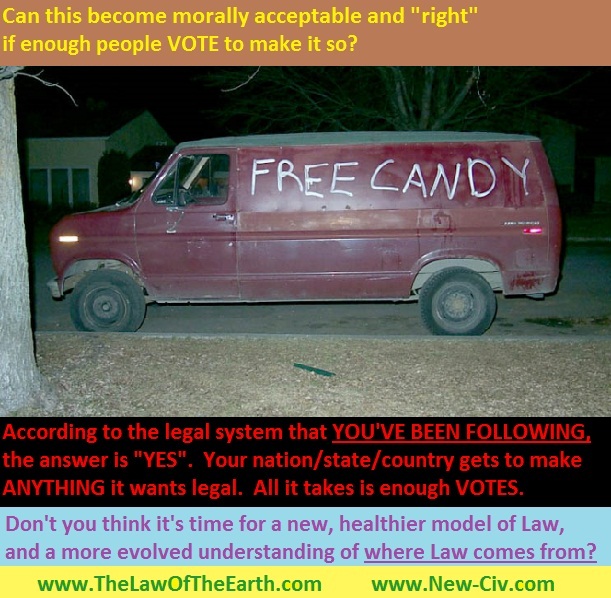
Under the majority-consensus model, the answer is yes. With enough votes, anything can be made "legal." There is no act so monstrous that a sufficiently large majority could not, in principle, make it lawful.
You don't believe that. No decent person does. You know there are things no majority can make right. And the moment you know that, you know that law doesn't come from the majority.
None of this is an argument against people deciding things together. Communities can and should cooperate, deliberate, and agree on how to share common work, as long as every person involved consents. What no majority can do is create law: decide right and wrong for someone else and then force it on them.
So who does make law?
"All right. I can see it. I don't have the authority to make law for anyone, and banding together with others doesn't give it to us. But we need some way to make laws. If We the People can't, who can? God? A king? Or should there be no law at all?"
Of course we need law. And we have law. It doesn't need to be passed or legislated, because it already exists, built into the structure of reality. We have all the law we need.
"Maybe you're right that governments can't make law. But then who are you? What gives you the right to say what the law is?"
That question has its own page: What gives you the authority to do this?
---
Other objections: This is crazy, silly, woo-woo! · Laws come from nations and governments · Laws come from God