The law has to be just. Otherwise it isn't law.
"That's not true. There are unjust laws. Slavery was legal."
Slavery was never law. It was a rule. And that difference is the whole point of this page.
Rules and laws
A rule can be made by anyone with the power to enforce it, whether it is just or not. A gang can make rules. A tyrant can make rules. A legislature can make rules. All a rule needs is someone willing to punish people who break it.
A law can never be made that way, because law is defined by what is just. It isn't produced by whoever holds power. It already exists, and it is discovered. A rule that contradicts it was never law to begin with, however many signatures are on it, however solemn the building it was signed in, and however many people were punished for breaking it.
Slavery was enforced with every instrument a state possesses: courts, police, statutes, the army. None of that made it law. It made it a rule, enforced by force, that was unjust from the first day to the last. The people who resisted it were not breaking the law. They were keeping it.
This idea is not new
The phrase on this page is old. It is usually traced back to St. Augustine, more than sixteen hundred years ago, and it was repeated by one of the great moral voices of the last century. Writing from a jail cell in 1963, Martin Luther King Jr. put it plainly:
"One has a moral responsibility to disobey unjust laws. I would agree with St. Augustine that 'an unjust law is no law at all.'"
And in the same letter:
"We should never forget that everything Adolf Hitler did in Germany was 'legal' and everything the Hungarian freedom fighters did in Hungary was 'illegal.'"
Everything Hitler did was "legal." Think about that sentence for a moment. If legality is the measure of right and wrong, then the Holocaust was right and the resistance was wrong. No sane person believes that. Which means no sane person really believes that legality is the measure of right and wrong. Beneath the habits we were taught, every one of us already believes in natural law.
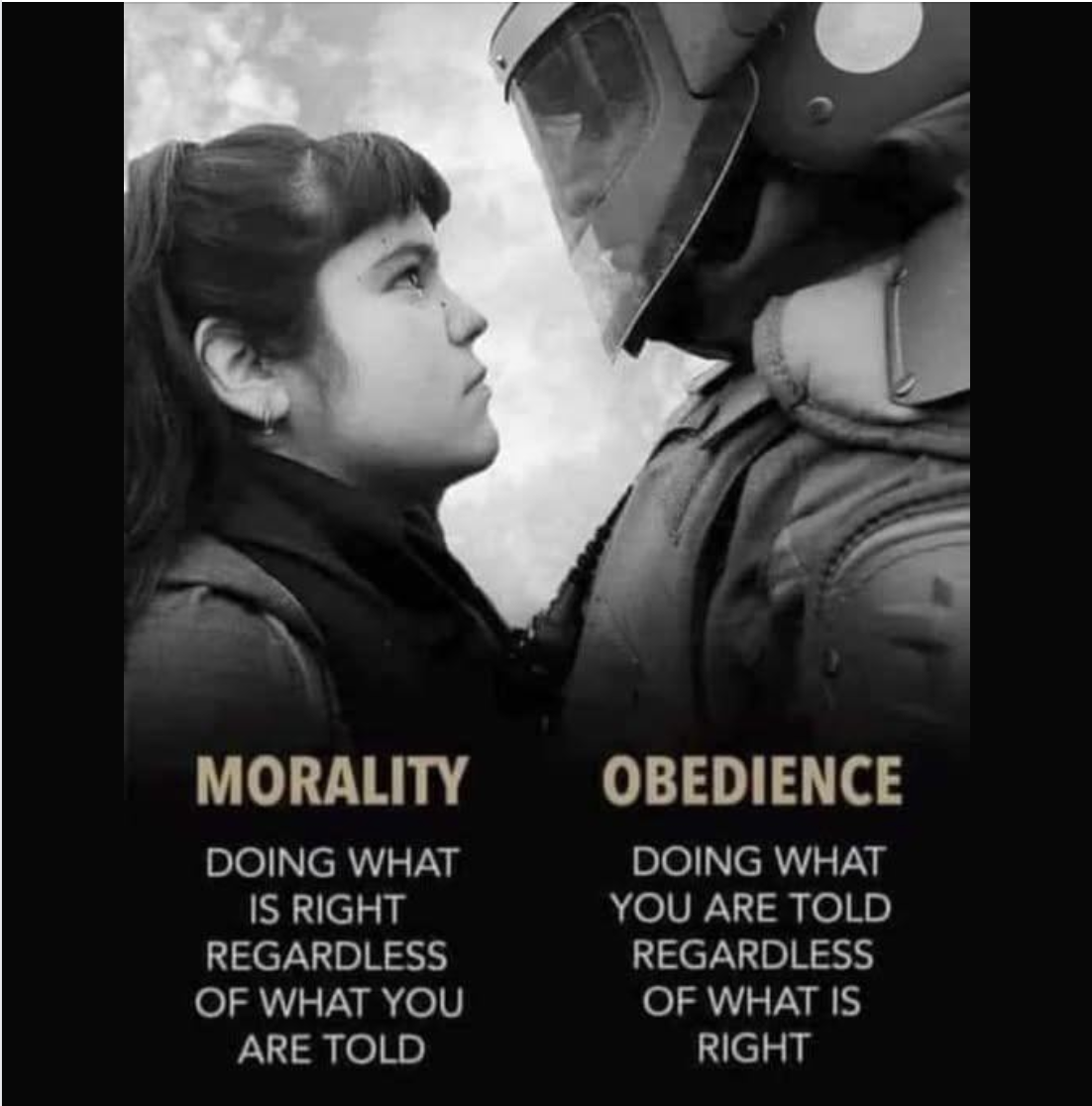
"You're just playing with words"
"This is just semantics. Call it a rule, call it a law, what difference does it make?"
The words matter enormously, because they frame the entire debate. The powerful have always taught the powerless to speak in a way that keeps the powerful on top. When you use vocabulary designed by slavemasters, you strengthen the arrangement that keeps them in power.
They want you to call their rules "laws," because the word "law" gives them an air of authority they have no right to. Calling their rules "laws" fixes those rules in place, and appears to justify the brutality used to enforce them. If a rule is "the law," then the person who breaks it is a criminal, and anything done to him seems deserved.
If you call rules laws, you are speaking the language of a slave.
If you believe that other people have the right to decide what is lawful and unlawful for you, and even to change the meaning of justice itself, then you are treating them as gods, or as your masters.
A threat with a gavel
Strip away the ceremony, and what is an unjust "law" really? It's a threat backed by force. Do this, or else. It has the same structure as a mugger's demand. The only differences are the costume and the paperwork.
That is not a cynical view of law. It is the opposite. It takes law so seriously that it refuses to give the name to a mere threat. Real law deserves our respect precisely because it is just. A rule that isn't just has no claim on anyone's conscience. It has only the power to hurt people, and power and authority are not the same thing.
Stop calling them laws
So stop calling them laws. Rules are not laws. People can make the first, but never the second. Law is a natural phenomenon.
No one owns you. No one makes law for you. There is one law: the Law of the Earth. It comes from nature, and it does not change at anyone's command.
This doesn't mean every rule is unjust. Many of the rules people live under, against murder, theft, and assault, are just, and they are just because they match natural law, not because a legislature approved them. Where a rule matches natural law, the authority belongs to the natural law, not the rule. Where it contradicts natural law, it has no authority at all.
Next: Have an objection? Start with Objections.