"This whole idea is crazy. I've never seen anything this nutty. A 'Law of the Earth'? There's no such thing. You're out of your mind."
Well, now. We appreciate the candor.
This objection usually arrives in one of two forms. Some people say it's crazy: it's so far from everything they were taught that it can't be serious. Others say it's woo-woo: it sounds mystical and airy, and they believe in science. We'll take them one at a time.
---
Part One: "This is crazy"
Since nothing we say right now is likely to persuade you, we won't defend our model just yet. Instead, let's look at yours.
If you reject natural law, you most likely believe in what we call the Nation-State Model: the idea that law is made by nation-states. And when you look at it squarely, the Nation-State Model is far stranger than anything on this site.
1. It's too big to know
Do you know how many laws your country has? In some countries, including the United States, nobody knows. Not the Department of Justice, not the Library of Congress, not any office in the entire government. No one can answer the simple question of how many laws there are.
There are so many that you are almost certainly breaking some right now. It's practically impossible to go through a day without violating some code, statute, or regulation. Simply by existing, you are a criminal, and there's nothing you can do about it.

By comparison, here is the Law of the Earth:
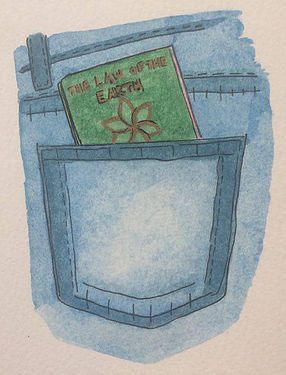
Which seems crazier: a law you can carry in your pocket and consult whenever you need it, or a law that can't be moved without a truck?
2. It's too complicated to understand
The existence of lawyers proves that something is wrong. An entire profession exists to work out how your legal system operates, because no ordinary person can. People study for years just to begin understanding it, and even then they master only one corner of it. No one understands the whole thing. No one.
If your "law" is so complex that the people bound by it can't understand it, isn't it obvious that something is wrong with it?
3. Right and wrong have a birthday
Every one of your "laws" has a birth date, a date before which it didn't exist. Before that date, something could be perfectly fine. After it, the same act is a serious crime. Or the other way around.
We don't mean customs gradually shifting in or out of acceptance over generations. We mean an abrupt and total reversal of right and wrong, in a single instant. At 11:59 PM, right and wrong are one way. At 12:01 AM, two minutes later, they're entirely different.
Can morality really work like that?
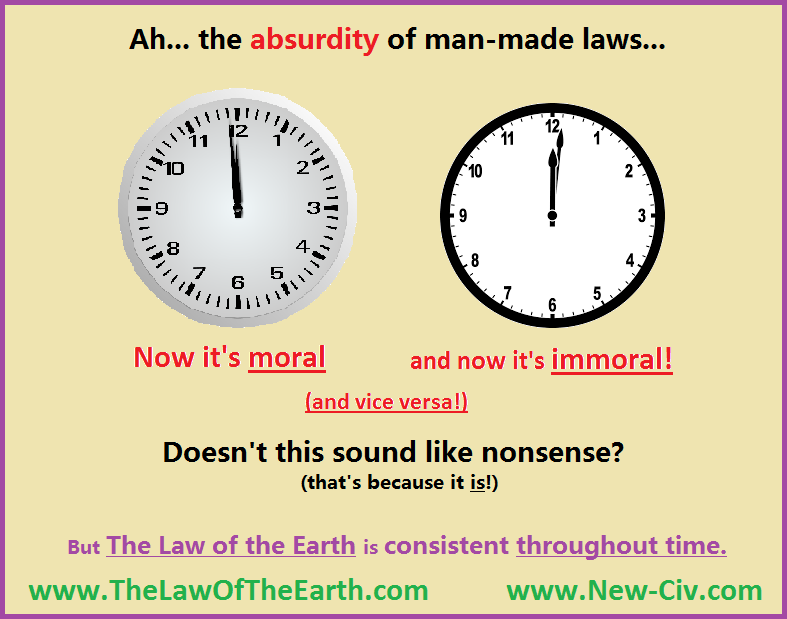
The Law of the Earth has no date of passage. It simply is. It has always existed, and it has always been the same.
4. Right and wrong change at the river
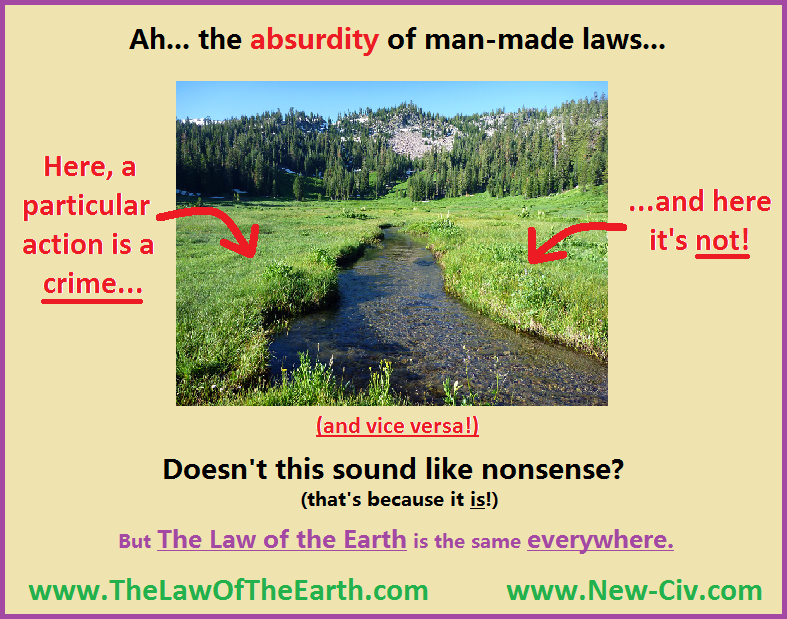
Every nation-state has a different set of "laws." Which one is correct? Nation-states "solve" this by assigning each set to a different patch of land. Cross from one country to the next, or one province, or even one town, and right and wrong change.
You can wade across a stream, and on the far bank the very meaning of being a good and decent person is different.
How can that be?
5. No dictator has ever violated human rights
Where do human rights come from? Are they part of what we are, or do they come from government? Do we have rights only if the government says we do?
North Korea and Saudi Arabia are widely recognized as violators of human rights. In North Korea, people have been imprisoned, tortured, and killed for criticizing the leader, practicing religion, or watching foreign films. In Saudi Arabia, people have been jailed, flogged, and executed for blogging, for questioning religion, or for dissent.
You probably think of these as horrific violations of human rights. But according to the Nation-State Model, the model you say you believe in, they aren't.
Under that model, human rights come from government. People have rights only if their government grants them. The North Korean government never granted its people those rights. Neither did Nazi Germany, the Soviet Union, or Pol Pot's Cambodia. If the people never had the rights, there was nothing to violate.
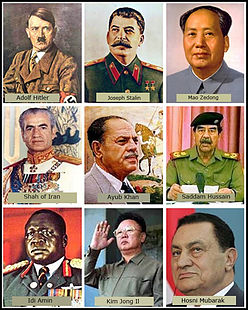
Follow it all the way through. If government is the source of rights, and the government doesn't believe you have any, then you don't have any, so there are none for it to violate. By definition, a dictator is someone who doesn't recognize human rights. So under this model, no dictator in history has ever violated a human right.
That is insane. And you know it.
The Law of the Earth recognizes that human rights are innate. They don't come from government. They come from existence. We are born with all of them. No government can grant them, and no legislation can take them away. That power was never theirs.
Doesn't that sound more sane?
6. It has no limits
Under the Nation-State Model, there is no limit on what can be made "legal." Theft? Certainly, as long as the right people take the right amount from the right people. Murder? Pass a law. Rape? Only get a majority first. Under this model, even the abuse of children could be made legal with enough votes.
The Nation-State Model places no limit on what a nation-state may do.
That's crazy.
So who's crazy?
We're not the ones who are crazy. What's crazy is what you've been taught all your life. Seeing how strange the Nation-State Model really is, wouldn't you at least be curious about a different one?
---
Part Two: "This is woo-woo"
"This is a bunch of woo-woo. You're claiming airy-fairy things I've never seen any proof of. I believe in science. Can you prove that morality exists independently of social norms? Can you prove that right and wrong exist before we define them?"
Yes, as a matter of fact, we can.
"Go ahead, then."
One simple question. Is child molestation wrong?
"Of course it is."
Why is it wrong?
"Because there are laws against it."
What if there weren't? What if lawmakers had never gotten around to outlawing it, or worse, what if they repealed the law tomorrow? Would it still be wrong?
"Yes. Some things are just wrong, always, no matter what the government thinks and no matter what society thinks."
Then human beings don't create law. As you just said yourself, some law exists whether or not anyone officially "makes" it.
Child molestation is wrong. Anyone who looks honestly at the question can see that for themselves, with or without a statute, with or without social agreement. Here, morality stands on its own feet, independently of any human opinion. Morality is a property of reality.
"But that's an extreme example. Of course that one is always wrong. Once you get into the smaller details, it isn't so black and white. There's a lot of gray area, where things are right or wrong depending on the norms of the society."
Wait. Don't skip past what just happened. You agreed that, in at least one case, right and wrong exist independently of human opinion. The example may be extreme, but it proves the principle: morality is, at least sometimes, objective, built into the nature of reality. And once that's true at all, natural law isn't woo-woo. It's simply the careful study of that fact.
Hard cases don't change this. Mathematics has hard problems too, some unsolved for centuries, and no one concludes from that that arithmetic is a matter of opinion. Gray areas mean the work is difficult. They don't mean there's nothing there to find.
So the "woo-woo" objection is finished. What remains is a different objection:
"Fine, morality is real. But morality and law are two different things. Morality may be part of reality, but law is man-made."
That one is answered in Objective Morality Means Objective Law.
---
Other objections: What gives you the authority? · Laws come from nations and governments · Laws come from God · Laws come from the consensus of the People