Right where you are standing, right now, there is a law that applies to you. It applied before you were born, and it will apply after every government now in existence is gone. It applies in every state, province, and nation, across the whole planet, for you, for me, for everyone.
It applies whether or not the government that claims the ground under your feet recognizes it, and whether or not anyone at all recognizes it. If not one person in the whole world acknowledged it, it would still be the law.
That is what we mean by natural law. And the claim of this section is a strong one: natural law is not one option among many. It is the only thing that has ever deserved the name "law."
Law is found, not made
We all know that reality works a certain way. It is whatever it is, and our job is to figure out what it is. You already accept this for mathematics, for geometry, and for physics. Nobody votes on the boiling point of water. Nobody passes a bill to set the value of pi.
Imagine a mathematician announcing that he has created a new principle of mathematics, by the force of his own will, by his compelling personality, or by the authority vested in him by some institution. You would laugh. Mathematicians do not legislate that two plus two equals four. They prove it, and they show you the proof, and you can check it yourself. Their authority is not the authority to command. It is only the authority of a good argument, which anyone is free to test, and which falls the moment someone finds the error in it.
It is no less absurd for a parliament, a king, or a congress to claim that it has created law.
The Pythagorean theorem, the speed of light, and the laws of thermodynamics were all real long before any human being wrote them down. Writing them down did not make them true. It only made them known. Law is the same. Its process is one of observation and reporting, never construction. It is not declared. It is discovered.
Discovered and reported. Not created and proclaimed.
Two choices
When you strip the question down, there are only two possibilities. Either law is like mathematics, a structure built into reality that we discover through reason. Or law is man-made, something some people create and then impose on others.
If law is man-made, then whoever claims to make it carries the burden of proof. They have to explain how, and why, they came to possess the authority to decide right and wrong for everyone else.
Every attempt at that explanation fails. Not because no one has tried, but because there is nothing there to explain. Mathematics doesn't merely make rational sense; it is rational sense. The man-made model can't even get started.
Here is the short version of why. (The full argument unfolds across the next three pages.)
Everyone is equal before the law. Everyone arrives with the same worth, the same standing, and the same basic rights. Those rights don't change from person to person; if anything about a person's standing changes, it changes only because of what that person chooses to do. The content of their character, as Dr. King put it.
If that is true, then no one owns anyone else, and no one has the authority to decide what is right or wrong for someone else. No one can make a law for another person. If someone could, it would mean that person owns the other and stands above them, and that contradicts the equality we just agreed on.
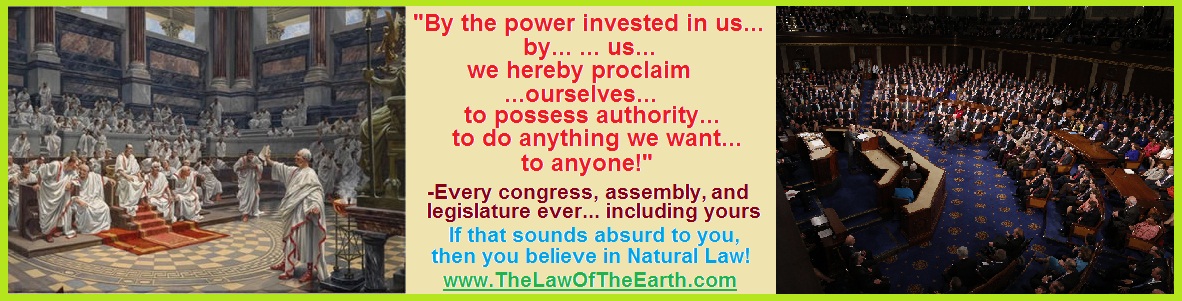
So no individual has the authority to make law. And if no individual has it, no individual can give it to anyone. You cannot hand your senator something you don't have. A hundred people with no authority to make law, gathered in a marble building, still have no authority to make law. Neither do a hundred million.
A house built on sand
If a plan is going to serve as the foundation for an entire civilization, it has to be grounded in something more solid than the will of whoever currently holds power. It has to rest on the deepest and most enduring reality there is.
Natural law is that foundation. It is the only law that justly and logically governs human affairs. Every other system of "law" is built, not on truth, but on the whims of whatever persons or groups have the power to enforce them. And a house built on sand falls.
Our own civilization is built on exactly this confusion. Its governments treat legislatures and courts as the ultimate source of law, instead of as fallible attempts to write down an order that already exists. They let "law" drift with fashion, power, and propaganda, so long as the correct procedure was followed, even when what was passed tramples life, bodily integrity, and truth itself. They almost never offer a public, step-by-step argument that a statute tracks anything genuinely right. The justification is political, not rational.
In other words, we have turned the hierarchy upside down. Instead of using natural law to judge human rules, we use human rules to overwrite natural law. A civilization that runs on that inversion cannot stand. Look around: it is already coming apart.
No one can move it an inch
Different people, trying honestly to discern the law, will sometimes reach different answers. That is true in mathematics too. But in mathematics, some answers are wrong, and only the correct ones are correct. It is entirely possible for a person, or an entire society, to hold a false idea of law. In fact, every nation-state in the modern world holds one.
And it does not matter how many people believe the false version, or how fiercely they believe it, or how much power they hold to punish those who won't go along with it. None of that changes one iota of what the law truly is.
All the king's horses and all the king's men couldn't put Humpty Dumpty together again. And all the lawyers and judges, courts and parliaments, councils, kings, queens, presidents, and congresses of the world can no more change one jot or tittle of the law than all the world's mathematicians, working in unison, could change the value of pi or repeal the Pythagorean theorem.
Where this section goes
The argument rests on three links, and the next three pages take them one at a time:
- Objective Truth Means Objective Morality — Truth exists independently of what anyone believes, and the truths about rights and dignity are among them.
- Objective Morality Means Objective Law — Law has a claim on anyone only because it rests on morality, so if morality is objective, law is too.
- Unjust Laws Are Not Laws at All — Which is why a rule that contradicts natural law was never law in the first place, however many signatures are on it.
And if you are carrying an objection right now, good. Natural law asks to be tested, not simply believed. You'll find the most common ones answered under Objections.