Humanity has passed through several great ages of industry: the Stone Age, the Metal Ages of bronze and iron, the Steam Age, the Electrical Age, and now the Digital Age. Each one was a complete economic system in its own right, and each one was simpler, more local, and less fragile than the one that came after it.
When a new age arrived, we didn't just add it on top of the old one. We tore the old one down. We let the skills die, paved over the gardens, and made the old ways illegal or impossible. Now nearly everything we need to live depends on the newest, most complex, most fragile layer of all.
A multi-layered economy fixes that. It keeps every layer alive, each one complete and self-sufficient, all overlapping in the same space, layered one upon the next.
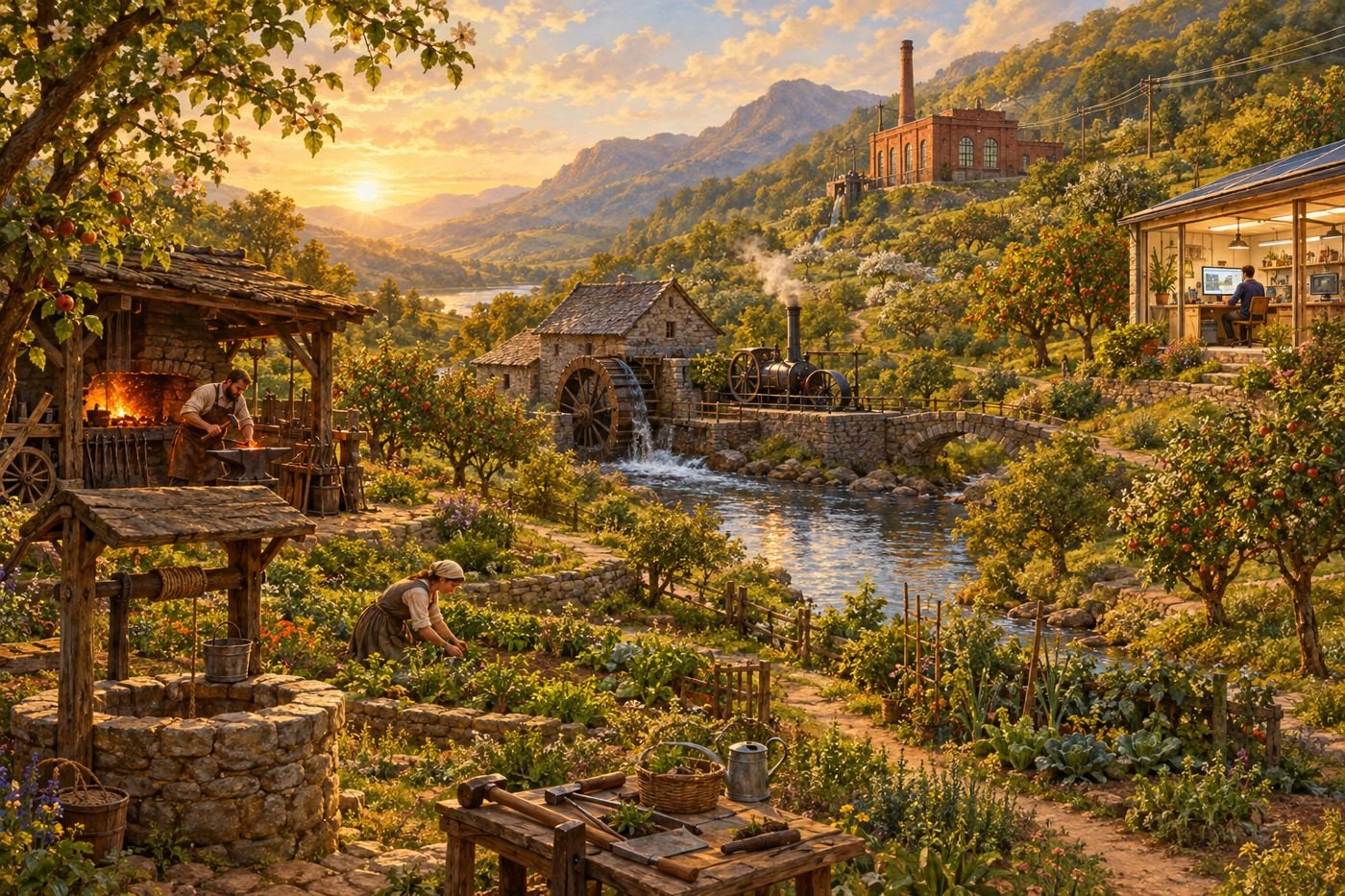
The Layers
| Layer | Social scale | What it provides |
|---|---|---|
| Stone | The Village | Hands, soil, and gift: food, water, basic tools, shelter, and one another |
| Metal | The Township | Craft, tool, and trade: smithing, repair, light industry, clothing |
| Steam | The City | Shared industry and machinery: heavy manufacturing, milling, rail |
| Electrical | The Metropolis | Power, current, and communication: electricity and the technology to make it |
| Digital | The widest scale | Computing, networks, and AI, serving everything below |
The bronze and iron ages are merged here into a single Metal layer, because at the scale of a township, they're the same kind of work: smithing, tools, and craft.
Why Do This?
For three reasons, plus a fourth that's just as real.
- Anti-fragility. If the power grid fails, or the internet goes down, or supply chains break, life goes on. The village still eats, the township still makes tools, and the city still runs its mills. Every layer is a safe haven for the ones above it.
- Efficiency. It makes no sense to ship wheat across an ocean to a place that can grow wheat, or to use a computer to do what a shovel does better. Each need is met at the simplest layer that can meet it well.
- Decentralization of power. When no single system controls everything you need, no single person or institution can hold it over your head.
- It's fun. Each of these ages holds a special, romantic place in the human heart. There's a reason so many books and films are set in them. We did our growing up there, as a species. The absurd complexity of the modern world is a big part of why everyone is going crazy, and we crave simplicity. A multi-layered economy lets us live in it again, without giving up anything.
The Seniority Principle
At the heart of the multi-layered economy is one rule of design: older, more basic systems must never depend on newer ones.
Newer technology can rest on older technology, but never the other way around. A refrigerator should not need the internet to keep food cold. A power plant should not be controllable from across the world through a network. A village should not need a car to get its food. Every time a basic need is made to depend on a newer, more complex system, it becomes fragile, and someone gains a lever over it.
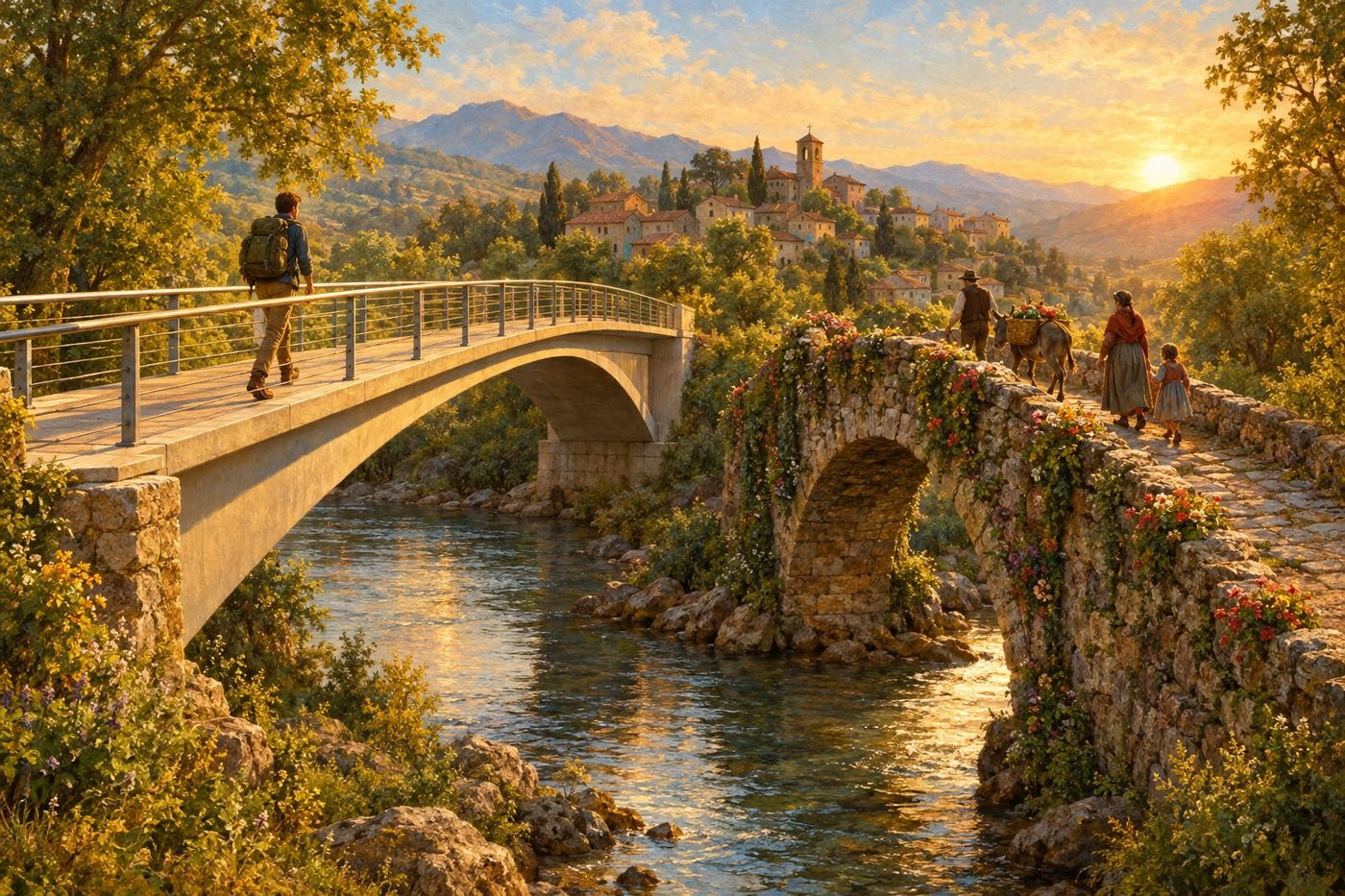
Cross the bridge; never burn it.
Progress means crossing the bridge into a new age. It doesn't mean burning the bridge behind you. Take cars: they're a fine invention. The mistake was paving over the gardens to make room for them, so that now we can't eat without them. A mature civilization would have built the roads and kept the gardens.
Technology Serves Life
None of this is against technology. It's against technocracy: the habit of thinking that technology is the goal, and that people exist to serve it.
| Healthy thinking | Technocracy |
|---|---|
| Life is the master. | Tech is the goal. |
| Technology serves life. | Life's "purpose" is to serve tech. |
A healthy civilization uses every tool it has, from the stone to the computer, and is ruled by none of them.
Not a Set of Rules
"Does this mean we can't import anything?" No. This isn't a set of rules. It's just a really good way to set up an economy.
If you live in Canada and want mangoes, import them. But you don't need to import wheat or barley, do you? And if someone makes artisanal chocolate in Switzerland that you love, enjoy it. The point is never to forbid anything. The point is to make sure that what you need to live, you can make close to home.
The aim is for each scale to be mostly self-sufficient in its own layer: the village in Stone, the township in Metal, and the city in Steam. How that begins, with neighbors who each do part of the work and together meet nearly every need, is told in Organize Your Village.
Money That Heals
In a multi-layered economy, the village layer runs mostly without money at all, on shared work and gift. Where money is needed, it should be created for one purpose only: to reward work that heals the Earth, such as planting trees, cleaning up toxic waste, removing concrete and asphalt, restoring waterways, and building villages that keep the Law.
Why This Is a Pillar
An economy is the way a civilization feeds, clothes, and houses itself. If every one of those needs hangs on a single fragile thread, the whole civilization hangs on it too. Keep every layer alive, and no single failure, and no single master, can bring it down.