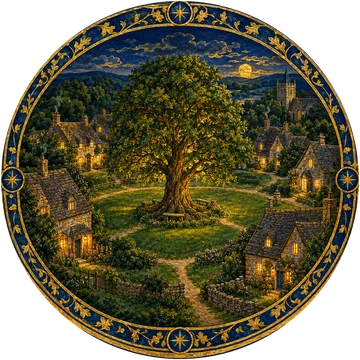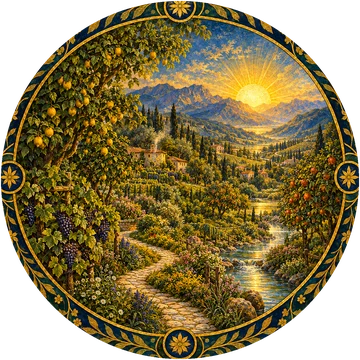
Land is the ground of everything. The way the world is built, the densest things are the foundations for the less dense things above them. Land is literally beneath our feet, the densest thing in our world, and every human activity takes place on top of it. Where we sleep, what we eat, how we move, who we see each day: all of it is shaped by how we arrange ourselves on the land.
Which means that if our relationship with land is sick, everything built on it will be sick too. And it is.
We Don't Own the Land
We think we own land. We don't. You gain ownership of a thing by creating it. If you paint a painting or build a gadget, it's yours until you decide to sell it or give it away. But you didn't create land, so you can't own it. And you can't buy it from someone else, because they never owned it either, and neither did whoever sold it to them. You can't sell what you don't own.
Our current relationship with land is a binary: either "this is mine, get off," or "this is someone else's, stay out." But in a healthy society, the relationship has layers. Instead of ownership, the Law of the Earth sets out specific rights for specific uses, running from the least intrusive to the most:
- Presence
- Foraging
- Hunting
- Stewardship
- Agriculture
- Territorialization
- Construction
- Extraction
The less a use changes the land, the more people have the right to it. Anyone may walk the land, and anyone may eat a ripe fruit from it. The more a use would change the land, the fewer people have the right, and the more it has to be justified to the Village that lives there.
The finger cannot own the hand;
a person cannot own the land.
How We Paved Over the Garden
Look at what our sick relationship with land has done to the way we live.
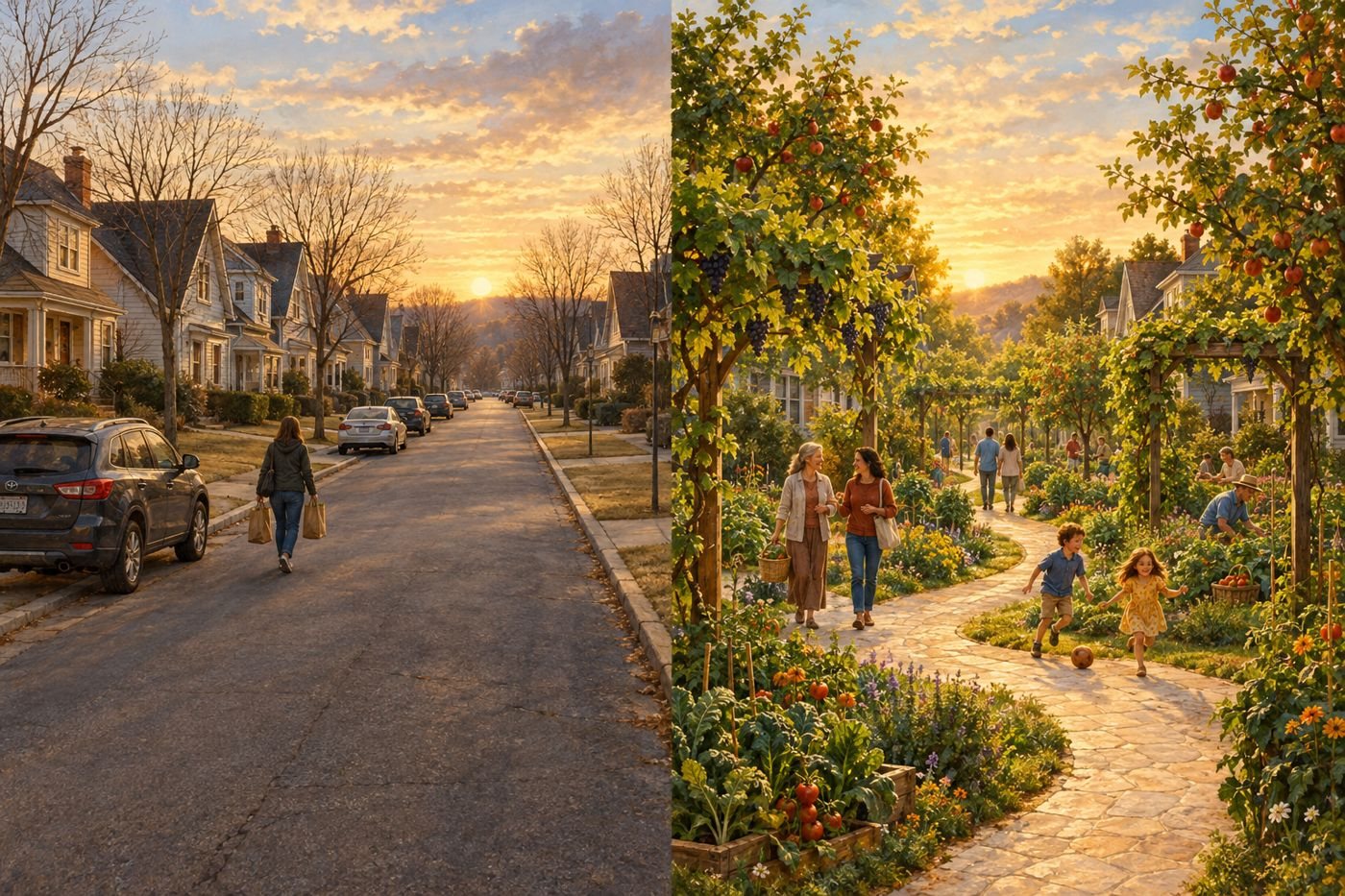
We built roads for cars, and to build them we paved over the gardens. Now that the gardens are gone, we have to drive to the supermarket to buy food that used to grow outside our door. So we need the car to get the food that the car's road replaced. It's a circle that feeds on itself, and every turn of it puts us further from the soil, further from each other, and deeper in debt.
It used to be that the village matron would cook a fresh meal for everyone, from food grown a few steps away. Now each of us drives alone to a building full of boxes, then drives home to eat alone. That is not progress. It's the land arranged backward.
Build the Map to Fit the Land
The modern habit is to draw a grid on a map and then terraform the land to fit it: flatten the hill, straighten the creek, cut down the trees that are in the way. We should do the opposite. Build the map to fit the land.
Imagine we set politics aside for a moment. Forget whether one camp would allow this much shared use, or another camp would allow this much freedom. Just ask: what is the best possible place for a human being to live? Design it as if we had no political baggage at all. Here is what comes out:
- Orderly, but not rigid. Mostly curves, following the contours of the land, with straight lines only where they're truly needed.
- Natural materials. Not concrete. Stone, and not awkward cobblestones but smooth, comfortable stone that's pleasant to walk on.
- Food everywhere. Trees and vines intertwined with everything, and most of them food trees and food vines. The strip between the sidewalk and the road, where we now grow grass that no one eats, becomes a garden.
- Built around what's already there. If a great tree stands where a house would go, build the house around the tree. There are places in China where this has been done for generations, with the trunk rising right through the home.
- Nature as the corridor, not the destination. You shouldn't have to drive to nature. You should live inside it, and move through it.
A Garden of Delight
Walking the Appalachian Trail, I noticed that whenever the trail crosses a road, you have to arrange some way to get from the crossing to the nearest inn: a shuttle, a hitchhike, a friend with a car. And I thought: why not just put the inn at the crossing?
Then it hit me that every place should be like that. We should create a world where you can spend your day walking through nature, exploring the land, ambling wherever your feet take you, with a place to sleep and good food all along the way.
Water has already mapped the continent for us. So let's make trails along every river, creek, and stream, nice and walkable, so you can look up at the sky instead of down at your feet. With shelters every mile and an inn at every crossing, almost everyone would live near the network, because almost everyone lives near water.
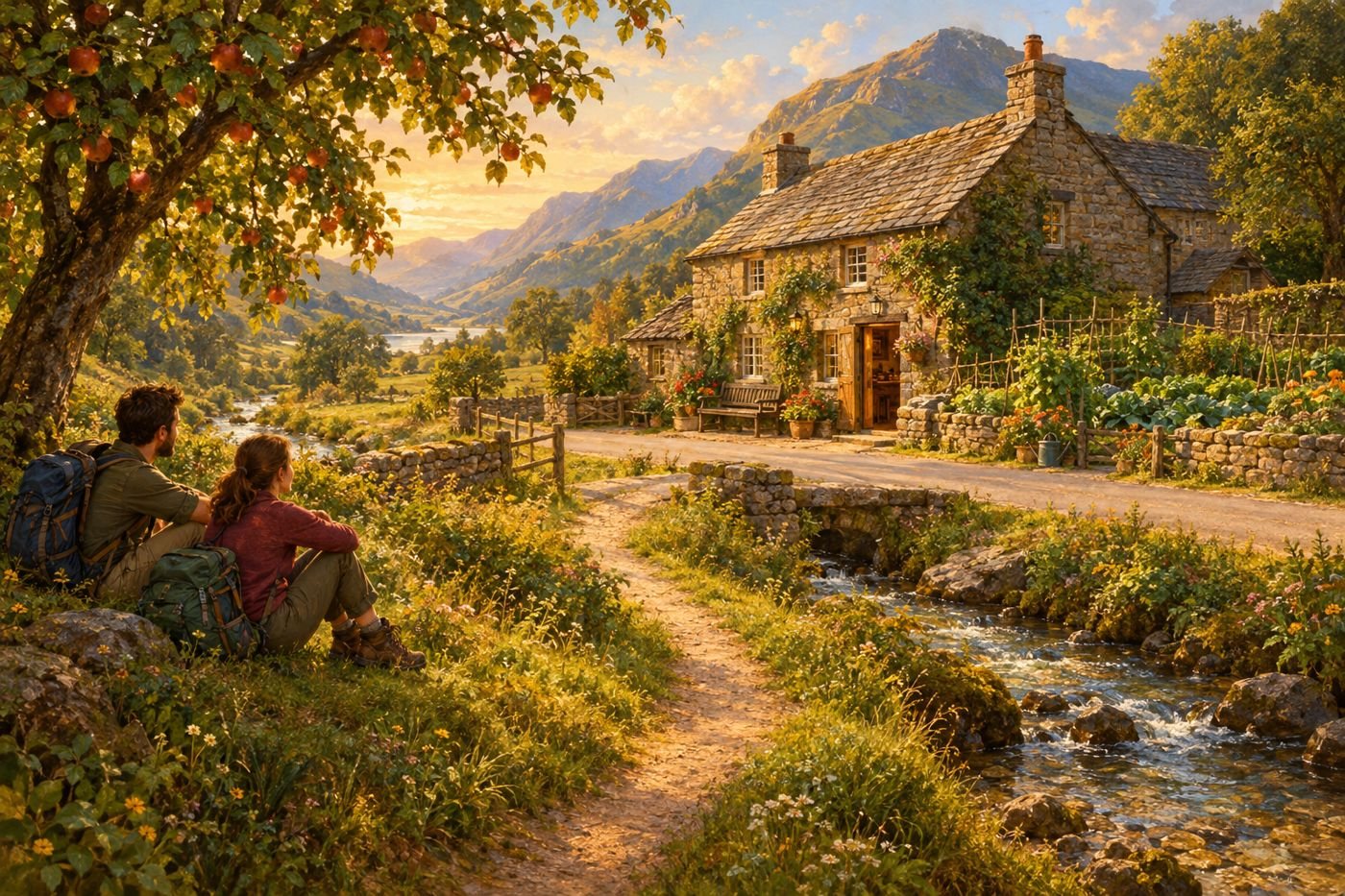
Let's turn the entire world into a hospitable garden of delight.
Why This Is a Pillar
Everything else in the Blueprint takes place on the land. A village can only be as healthy as the way its homes, gardens, and paths are arranged. An economy can only be as sound as its relationship with the soil and water it depends on. Restore our relationship to the land, and every other pillar has solid ground to stand on.