In the current system, millions of people vote for candidates they have never met, will never meet, and know only from television and advertisements. Politics becomes a contest of celebrity. The people who win are distant from the people they rule, and no good decision-making can come out of a system like that.
Land-Based Sequential Delegation fixes it. Every election is held in person, and everyone votes only for people they personally know.
The closer the center of power is to where you live,
and the smaller the group being ruled,
and the more directly you know the leaders,
the more power you have.
How It Works
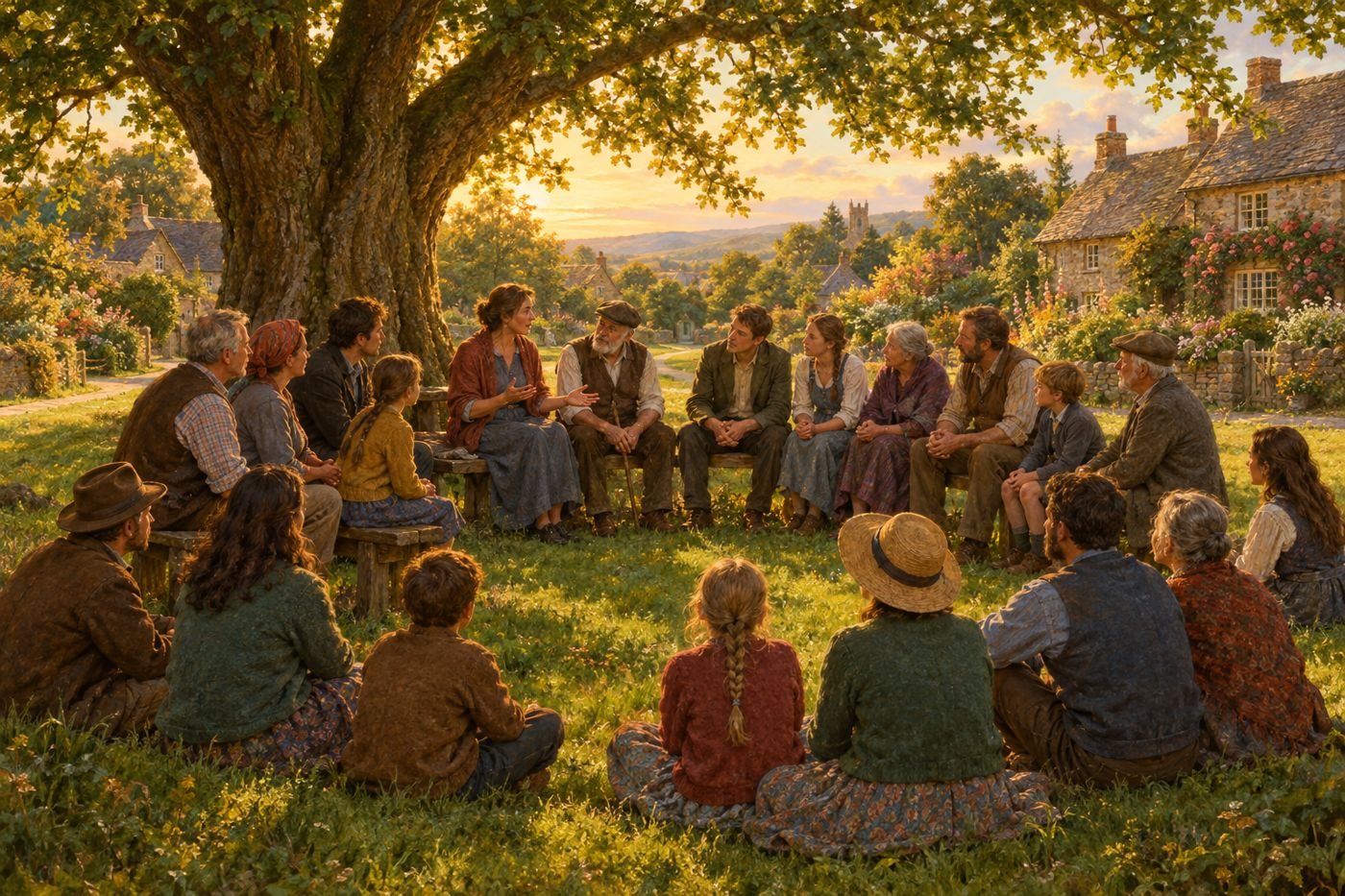
It begins in the village. The people of the village gather on the Green, in person, and choose from among themselves the wise people who will sit on the Village Council. The council then sends one of its members, someone everyone there knows well, to the Township Council.
The Township Council is made up of one delegate from each of its villages. It, in turn, sends one of its members to the City Council. And so on up the ladder: at every level, the person elected at the level below votes at the level above, in person, among people they actually know.
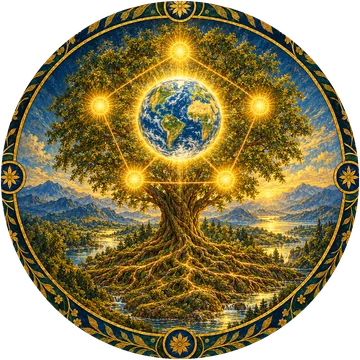
The result is a chain of trust that runs unbroken from your front door to the Planet. You know your village councilor. Your councilor knows the township councilors. They know the city councilors. No one, at any level, is voting for a stranger.
The Levels
| Level | Population | Area | Self-sufficient in |
|---|---|---|---|
| Village | 30 to 300, ideally about 150 | An urban rowhouse block, a large apartment building, a few suburban blocks, or a traditional village | Water, nutrition, basic tools, energy, and social life |
| Township | 10 to 30 villages | A central area of about one square kilometer, plus every village within walking distance | Light industry, recycling, repair, intermediate tools, shelter materials, clothing, and basic culture |
| City | At least 20 townships | A central area of about ten square kilometers, plus the surrounding townships | Heavy industry, energy technology, and every kind of cultural pursuit |
| Bioregion | Set by natural geography, not population: 15 to 30 across the Earth | A natural division of the planet: mountain, ocean, desert, forest, polar, and so on | Not an economic unit |
| Planet | Everyone | The whole Earth | Law, morality, and governance |
Between the city and the bioregion, cities may also gather into a metropolis, or nation, where the land and its peoples make that natural.
Notice that the bioregions are drawn by nature, not by politics: mountains, oceans, deserts, forests, and polar lands. The aim is for the Planetary Council to hear from as wide a range of the Earth's biomes as possible. Diversity of experience adds wisdom.
Cells, Organs, Body
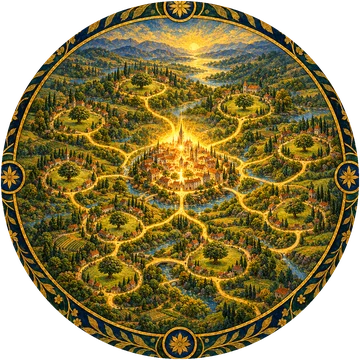
The city is a collection of townships, and the township is a collection of villages, the way a body is made of organs, and organs of cells. The village is the basic social unit. The township grows out of villages working together, and the city out of townships.
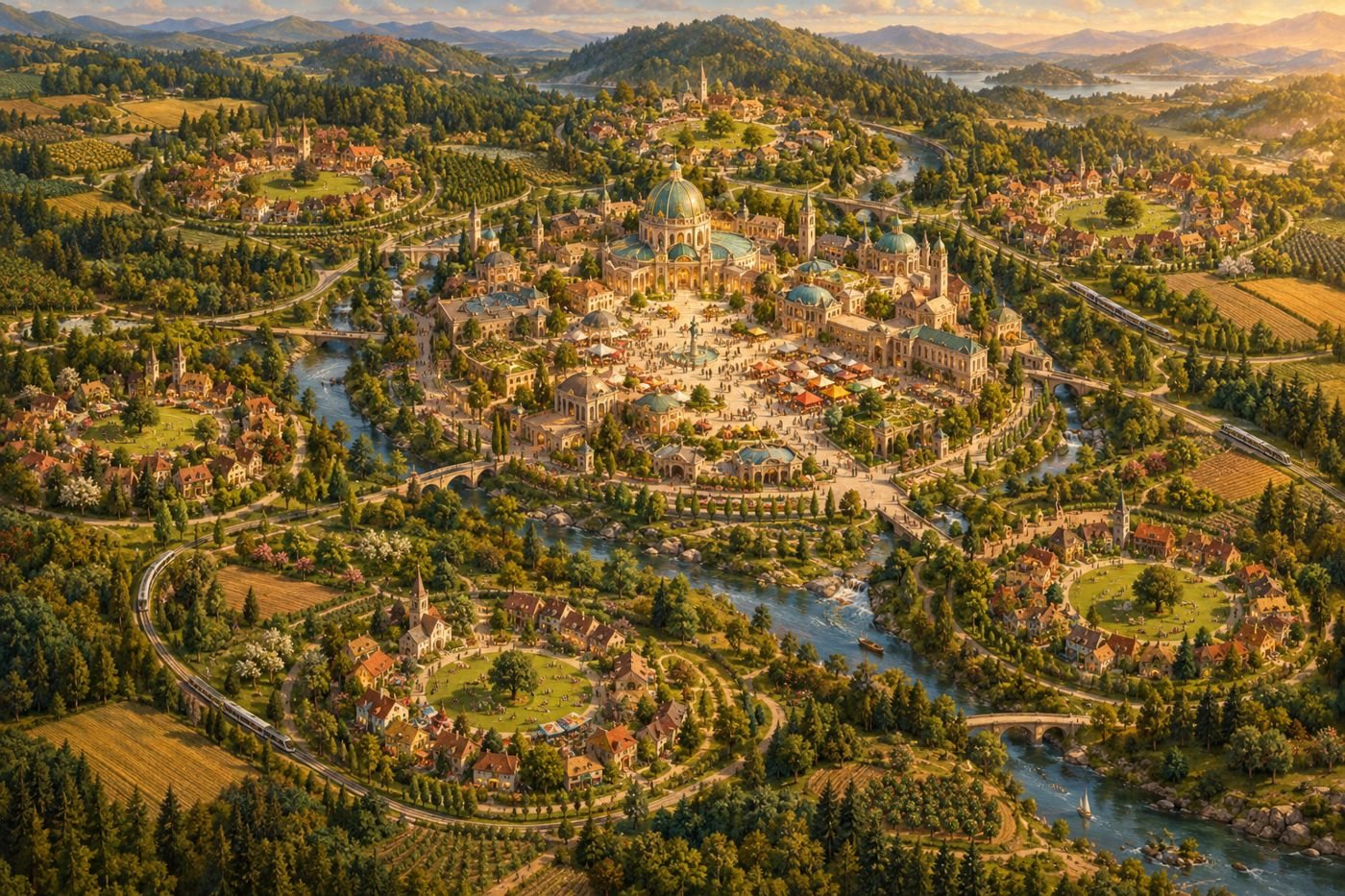
That means a person who loves a quiet life, a person who loves a bustling town, and a person who loves the energy of a city can all have what they want within a short walk or ride of each other. Today you often have to travel for hours from the city center to reach anything like a village. In a well-designed city, you'd never be far from one.
It also means no duplication. Many cities today have several separate centers, a few miles apart, each with its own fraction of the nightlife and culture. But the whole point of a city is to bring a great many people together in one place, because that's where the magic happens. A well-designed city has one urban core, where everyone can meet.
Building It, Step by Step
Once the first villages are working (see Organize Your Village), the next levels form in the same way. None of these steps has to be finished before the next one begins. Just get the ball rolling.
- Connect the villages. Build footpaths and simple transit between neighboring villages.
- Elect village delegates. Each Village Council chooses one of its members to represent it.
- Form the township. The delegates meet in council.
- Make a township plan. Choose the routes between townships, work toward self-sufficiency in light industry, and share the work without money.
- Build transit to the other townships.
- Elect township delegates.
- Form the city.
- Make a city plan. Choose the routes between cities, and work toward self-sufficiency in heavy industry.
- Build transit to the other cities.
At its final stage, Land-Based Sequential Delegation reaches the whole Earth. That stage is the Republic of the Earth, and it forms rather late in the process, built from the ground up out of everything below it.
The Size of a Council
How many people should sit on a council? We know that enormous bodies of hundreds of people are terrible at deciding anything. They need separate committees, hearings, and parliamentary procedure just to function. 435 is too many. 100 is too many.
The research points to a number close to fifteen. Bain & Company's studies of decision-making found that every member added beyond seven cuts a group's decision effectiveness by about 10 percent, and that groups of seventeen or more rarely decide anything at all (Bain & Company). A study of national cabinets found most have between 13 and 20 members, with effectiveness dropping sharply past about 20 (Klimek et al.).
So at every level, councils should hover around fifteen members: large enough to hold real wisdom and diversity, small enough to actually decide, and an odd number, so there are no ties.
Voting on the Land
When a decision concerns a particular piece of land, the people closest to it, and who have lived there longest, carry the most say:
V = T / D
Votes equal Time divided by Distance.
The longer you've lived near a place, and the closer you live to it, the more weight your voice carries on what happens to it. A larger body may check a village's wish to alter its land, but may never force an alteration on a village that doesn't want it. And it's always best to err toward letting the land be.
Why This Is a Pillar
Power always drifts toward whoever is furthest away and least known. Land-Based Sequential Delegation pulls it back to where it belongs: to the land, and to the people who live on it and know each other. It's the bridge between the village and the whole Earth.