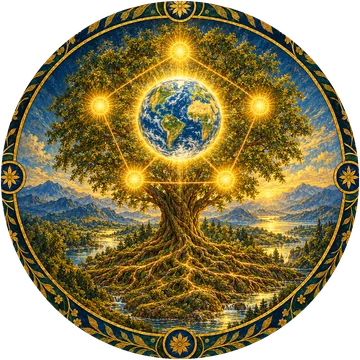
The Republic of the Earth is the final stage of Land-Based Sequential Delegation: the point at which the chain of councils, rising from village to township to city to bioregion, finally reaches the whole planet. It is not imposed from the top. It is built from the bottom, out of everything beneath it, and so it forms rather late in the process.
Its purpose is simple. Below the planet, every level governs what belongs to its own scale, and no more. What a village can decide, no city should decide for it. But some things concern the whole Earth: the Law itself, the protection of the planet's living systems, and the peace between peoples. Those belong to the Republic.
The Five Branches
The Republic has five branches, and each of them exists at every level, from the village to the planet.
- The Council makes the decisions. It is small, about fifteen members, and made of the wisest people each level can find.
- The Assembly is the people themselves. It is not elected: every member of the community has the right to assemble, voice their concerns, and tell the Council what needs to be addressed.
- The Senate is appointed by the legacy governments. During the transition to the new civilization, it informs the Council about practical and logistical matters, so that nothing important is lost as the old system winds down.
- Guardianship upholds the Law of the Earth. It may use force, but only for that.
- Service pursues projects to improve life. It may not use force at all.
The Assembly and the Senate give the Council information. The Council gives Guardianship and Service their instructions.
The Two Hands
Guardianship and Service are the two branches that act in the world, and they are kept strictly apart.
| Guardianship | Service | |
|---|---|---|
| Purpose | Upholds the Law of the Earth | Pursues projects to improve living |
| Force | May use force | May not use force |
| Appointed by | The Council | The Assembly |
This is the same separation that runs through the whole Blueprint: force and betterment are never held by the same hand. The branch that may use force may pursue nothing but the Law. The branch that pursues a better world may use nothing but consent. (See The Three Bodies.)
Five Branches at Every Level
| Council | Assembly | Senate | Guardianship | Service | |
|---|---|---|---|---|---|
| Village | Village Council | Village Assembly | Village Senate | Village Guardianship | Village Service |
| Township | Township Council | Township Assembly | Township Senate | Township Guardianship | Township Service |
| City | City Council | City Assembly | City Senate | City Guardianship | City Service |
| Bioregion | Regional Council | Regional Assembly | Regional Senate | Regional Guardianship | Regional Service |
| Planet | Planetary Council | Planetary Assembly | Planetary Senate | Planetary Guardianship | Planetary Service |
How Each Branch Is Filled
Councils. The Village Assembly chooses the wise people of the Village Council. Above the village, each council accepts one member from each unit beneath it: one from each village for the Township Council, one from each township for the City Council, one from each city for the Regional Council, and one from each bioregion for the Planetary Council, sometimes called the High Council. At every level, the council should hover around fifteen members. (The reasons are on the Land-Based Sequential Delegation page.)
Assemblies. At the village, township, and city levels, the Assembly is simply everyone, gathering in person. At the scale of a bioregion or the whole planet, where no one can gather in a single place, the Assembly takes the form of Real-Time Democracy, administered by the Regional Council and the High Council.
Senates. Appointed by the legacy governments, for as long as they exist.
Guardianship. Officers appointed by the Council.
Service. Members appointed by the Assembly.
Why This Is a Pillar
Every civilization needs some way to make decisions that concern everyone. The current system's way is to let a distant few, chosen by strangers, claim the power to make law. The Republic of the Earth does the opposite. It makes no law, because law can't be made. It upholds the Law that already exists, and pursues a better world only by consent. And every one of its members is known, personally, by the people who sent them.