A forest grows thousands of tons of living things every year, and nobody plows it, nobody sprays it, and nobody waters it. It feeds itself, waters itself, fertilizes itself, and gets richer every year. Our farms do the opposite. They strip the soil, spray it with poison, and need more and more inputs every year just to keep producing.
Permaculture asks a simple question: what if we grew our food the way a forest grows?
What Permaculture Is
The word means "permanent agriculture," and also "permanent culture." It was developed in Australia in the 1970s by Bill Mollison and David Holmgren as a way of designing human settlements that work with nature instead of against it. It rests on three ethics, which Mollison set down and Holmgren's principles serve (NC State University):
- Earth care. Look after the soil, water, plants, and animals.
- People care. Look after yourself, your family, and your community.
- Fair share. Take what you need, and return the surplus.
You may notice that these sound a great deal like the Law of the Earth. That's no accident. Good design, like good law, is discovered in the way the world already works.
The Twelve Principles
Holmgren gathered permaculture's thinking into twelve design principles (Holmgren, Essence of Permaculture):
- Observe and interact.
- Catch and store energy.
- Obtain a yield.
- Apply self-regulation and accept feedback.
- Use and value renewable resources and services.
- Produce no waste.
- Design from patterns to details.
- Integrate rather than segregate.
- Use small and slow solutions.
- Use and value diversity.
- Use edges and value the marginal.
- Creatively use and respond to change.
The first is the most important. Before you plant anything, watch the land for a while. Where does the water run when it rains? Where does the morning sun fall, and where does the frost settle? The land will tell you what it wants, if you take the time to listen.
The Food Forest
The heart of permaculture is the food forest: a garden built in layers, the way a natural forest is, except that nearly everything in it feeds you.
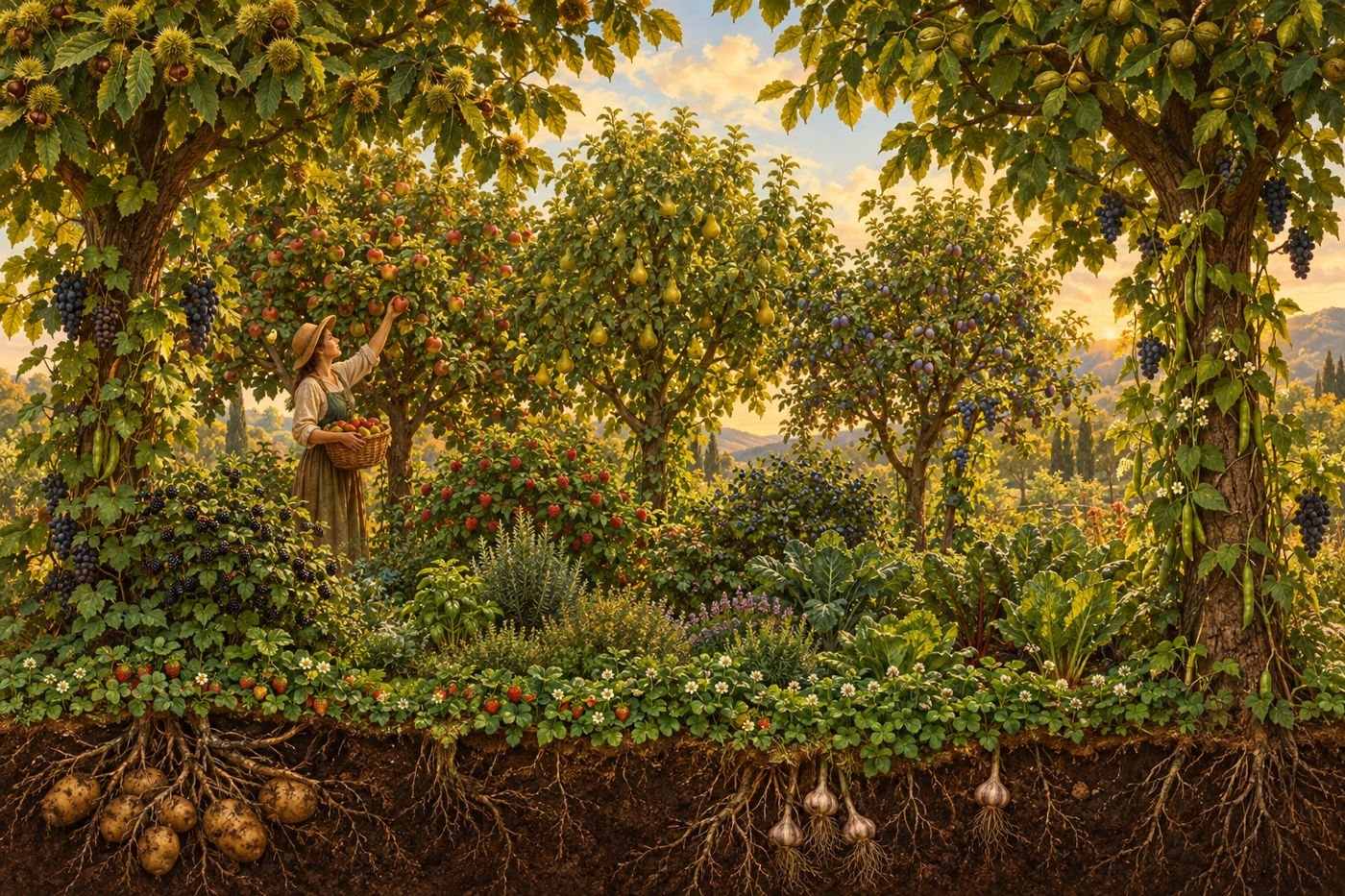
- Canopy: tall nut and fruit trees, like chestnut, walnut, and pecan.
- Understory: smaller fruit trees, like apple, pear, plum, and peach.
- Shrubs: berries, like currants, gooseberries, and blueberries.
- Herbs: culinary and medicinal herbs, and perennial vegetables.
- Ground cover: strawberries, clover, and creeping herbs that shade the soil and keep it moist.
- Roots: potatoes, garlic, onions, and other crops below the surface.
- Vines: grapes, kiwis, and climbing beans, reaching up through the rest.
Plant the right things together, and they help each other. Some pull nitrogen from the air into the soil. Some draw up minerals from deep down. Some flowers bring in the pollinators, and some plants keep pests away. These helpful groupings are called guilds. Once established, a food forest needs very little work: no plowing, little weeding, and less watering every year as the soil comes alive.
Zones
Permaculture places things by how often you need them. Whatever you visit every day, like the herb garden, the chickens, and the salad greens, goes right beside the house. Fruit trees you visit weekly go a little further out. The woodlot and the wild places go furthest of all. That's exactly how a village is laid out: the personal garden beside each home, the Village Garden around the green, and the wild land beyond.
It Works, Even in the City
You don't need a farm. The Dervaes family in Pasadena, California grows thousands of pounds of food a year on an ordinary city lot of about a fifth of an acre, with hundreds of varieties of plants and their own chickens for eggs (PBS SoCal; Resilience). That's one family on one lot. Imagine what a whole village could grow on a shared green.
If you'd like to see food forests in action, here are a few good videos to start with:
- A Forest Garden With 500 Edible Plants (National Geographic)
- Couple Transform Land into an Amazing Permaculture Food Forest (Happen Films)
- Organic Regenerative Farming Is the Future of Agriculture (Happen Films)
Why This Is a Pillar
Food is the most basic need there is, after air and water. A village that can feed itself can't be starved into obedience, can't be poisoned by distant factories, and doesn't need money to eat. Permaculture is how the village feeds itself, and how the land heals while it does.