There's no reason to be cruel, ever. There's always a different way to do things.
That goes for how we treat each other, and for how we treat animals. Cruelty has no place in the civilization we're building, not toward a prisoner, not toward a child, not toward a stranger, and not toward a chicken.
All People
The Law of the Earth already protects every person from harm, through Title 1: Human Rights. But a society can obey the letter of its laws and still be cruel: in its prisons, in how it treats the poor, the sick, the addicted, and the homeless, and in how it punishes. The Earth Party rejects all of it. Where harm has been done, we look for healing and restitution, not revenge. (See Truth and Reconciliation and The Drug War and Prisons.)
Abolish Factory Farming and Mechanized Slaughter
Let's start where everyone should agree. Factory farming and mechanized slaughter are abominations. We call for their total abolition.
That doesn't mean giving up meat. Maybe humanity should stop eating animals, and maybe it shouldn't. (See Veganism?.) Either way, people ate animals for thousands of years without factory farms or slaughter by assembly line. We can abolish those two abominations without settling that question first.
Cruelty Is a Level of Consciousness
The problem with factory farming isn't only that it's cruel to the animals, though it is. Cruelty affects more than its victims.
It's the Earth Party's view that cruelty is a level of consciousness. To take part in factory farming and mechanized slaughter, a person has to lower themselves into cruelty. And when a whole society does that, as a matter of routine, it brings down the spiritual condition of the whole society.
It's one thing to eat the flesh of an animal that lived a normal life. It's another thing to eat the flesh of an animal that was confined and tormented its entire life, then slaughtered on an assembly line, in terror. We believe that terror and suffering go into the flesh, and into whoever eats it.
What the Science Says
Science doesn't measure spiritual energy. But it does measure stress. Meat scientists have long known that stress before slaughter changes the meat itself. In pigs, for example, acute stress just before slaughter is linked to pale, soft, watery meat, and longer-term stress to dark, firm, dry meat, both considered defects in quality (Animals, 2021; International Journal of Veterinary Science and Medicine, 2020).
The Village Herd
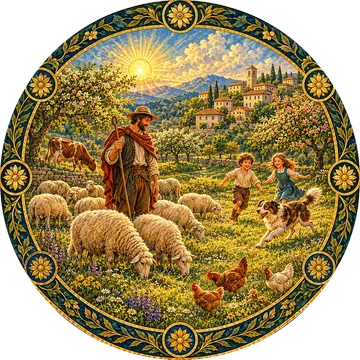
The multi-layered economy solves much of this on its own. When animals are raised in the village, you can see how they live. You don't have to wonder, because they're right there.
The Law of the Earth calls for all animal-based food production to be managed at the village level, "one herd per species per village," by personal care, never by automation, and open to visitors at all times (Title 2: Animal Rights). One flock or herd per village lets the animals live in their natural social unit, while everyone in the village shares in what they provide, whether it's milk, eggs, or meat. And it saves labor: you only need one shepherd, or one cowherd, instead of every family looking after its own animals.
The same goes for dairy and eggs: no factory conditions. Any community with the land for it can keep cows. Every village can keep a flock of chickens.
There Is No Price of Eggs
During the last election, people worried about the price of eggs. But there's no price of eggs if you're not buying them. When the chickens live where you live, you just walk outside and look under the bushes where they usually lay. If they're not under this bush, they're under that one. Check a few bushes, and you've got your eggs.
What You Can Do Now
In the meantime, the grocery store shelves are full of meat from factory farms and mechanized slaughterhouses. Yes, meat raised the right way costs more. But we believe it's healthier, and that what you save in medical bills, and gain in quality of life, will make up for it.
Buy From the Farmer
Go directly to a farm. Many farms deliver now, even into the city, or have pickup points. But find out for yourself that the animals weren't raised in factory conditions, and that they were slaughtered by traditional, non-mechanized methods.
Know Your Egg Labels
In the United States, the labels on egg cartons are confusing, and some mean less than they sound.
- "Cage-free" and "free-range" do have official definitions, from the U.S. Department of Agriculture, for eggs that carry its grade shield. "Cage-free" means the hens weren't in cages, but they may still be crowded indoors. "Free-range" means they also had some access to the outdoors, which may be small (USDA; Academy of Nutrition and Dietetics).
- "Pasture-raised" has no single federal definition. So look for a third-party certification on the carton that sets real standards for outdoor space (Academy of Nutrition and Dietetics).
The best eggs, of course, are the ones from your own village flock.
Look at the Yolk

Have you noticed how pale the yolks have gotten? A yolk's color comes mostly from what the hen eats. Hens on pasture eat grass, plants, and bugs, and tend to lay eggs with deeper orange yolks. In one study, pasture-raised eggs had about twice the carotenoids, and about three times the omega-3 fats, of cage-free eggs (Foods, 2022).
But be careful: color alone can be faked. Factory producers can darken yolks by adding marigold or paprika to the feed (Scientific American). So a pale yolk is a warning sign, but an orange one isn't proof. Knowing the farm is.
Improve Our Relationship With Dogs
Dogs have lived alongside people for thousands of years. But modern life is often hard on them. Many dogs spend eight hours a day or more alone in an apartment, or worse, in a cage. For a social animal, that's torment. We shouldn't be doing it that way anymore. And if you're a dog guardian who goes to work all day, you probably already feel bad about it.
The Doggy Ranch
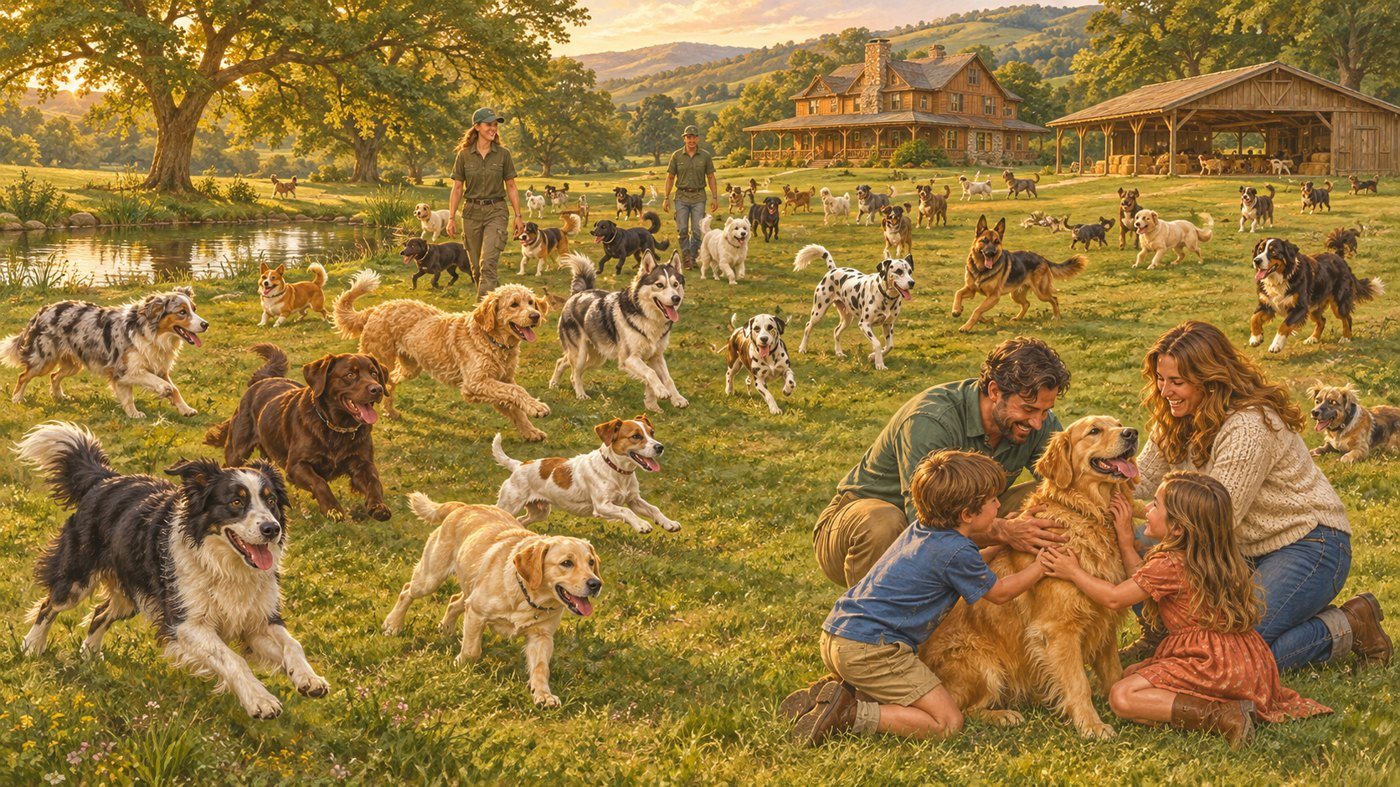
We want there to be doggy ranches. If you have a dog, but you don't have the time or the space to give it a happy life, you can let your dog live at the ranch, with a pack of other dogs, and room to run.
And you can visit and play with your dog whenever you want. You can check your dog out to take it for a walk, or bring it home for a while, and bring it back whenever you like. It's not a commitment either way.
Be honest. Isn't that how you wanted it anyway? To play with your dog and cuddle it, without the burdens: not just cleaning up after it, but worrying about whether it's lonely, or whether it's happy sitting alone in a room all day.
Three Benefits
- You're free of the burdens. No more cleanup, no more guilt about leaving your dog alone all day, and no more turning it away when it wants to play and you're busy.
- You save money. At scale, food and care cost less per dog. And since the dogs live happily, they need fewer trips to the vet. A happy dog is a healthy dog.
- The dogs are happier. They live in a pack, outdoors, the way dogs are meant to live.
This fits the Law of the Earth, which says that no animal is property, and that a companion animal should never be kept in a cage or pen, but only by mutual affection (Title 2: Animal Rights).