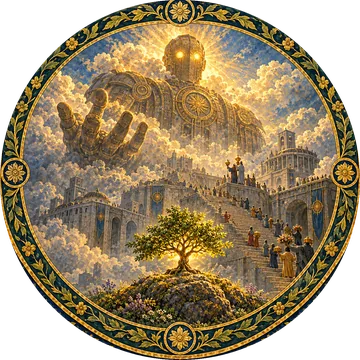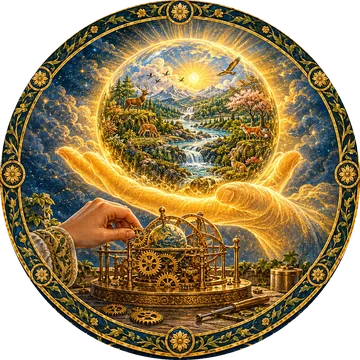
The ancient Greeks had a word, techne, for craft: the skill of making things. It's the root of our word "technology."
But behind every act of making is a way of thinking. To want to remake the world is to believe that the world, as it is, is somehow wrong. And to believe we can remake it into something better is to believe that the human intellect is superior to the order of Nature that produced it.
Is that a wise assumption? Let's examine it.
Perfect or Imperfect?
Either the Creation is perfect as it was created, or it isn't.
If it's perfect, then by definition there's no need to alter it. There's no need to improve on it, because there's nothing to improve.
And if it's imperfect?
Then human intellect is imperfect too, because it exists within the Creation. If everything in the Creation is flawed, then so is the mind of Man, which is part of it. And if the mind of Man is flawed, so is everything it makes.
Twice Flawed
So technology isn't just flawed. It's doubly flawed.
Nature was made once, by the intelligence of the Creator, whatever name you give to that intelligence. Technology was made twice over: first, the human mind was made within Nature, and then that mind made the machine. There are two levels of creation involved, and two chances to make mistakes.
If the original Creator was a careless enough architect to make a flawed world, then Man, working inside that world, with a mind made by that same architect, is likely to make a flawed world too. His errors would be built on top of the Creator's errors. Error would compound on error.
So the path of technolatry, the path of using technology to "fix" the world, isn't likely to make the world better. It's likely to make it worse.
The Ratio of Nature to Technology
If technology is a less perfect ordering of the world than the Nature it replaces, then the health of the world depends on the ratio between them: the once-flawed Creation of the Creator, against the twice-flawed machinery of Man.
The more Nature there is, the healthier and more stable the world will be. The more of Nature that gets converted into technology, the less stable the whole system becomes.
The historical record bears this out. The further down the technolatric path we've walked, the more our civilization has come into conflict with Nature, and the less content we've become. (See The False Promises of Technolatry and Technology Failed at Its Central Purpose.)
This doesn't mean all technology must go. A digging stick is technology. So is a well. The question is one of proportion and of order: whether technology stays small, rooted, and in service to Nature, or grows until it replaces Nature. That ordering is drawn out in The Pyramid of Technological Emergence.
The Fork in the Road
Once all of this is admitted, the path forks.
On one side is humility. We can admit that placing our hopes for salvation in the works of our own hands was a mistake. We can come clean, and say, "We chose the wrong path."
On the other side is pride. We can refuse to admit the error, cling ever tighter to our faith in technology, and keep going.
Only one of those paths leads to a world with a future.
What Technolatry Forgets
Those who choose twice-flawed technology over once-flawed Nature believe that the works of Man will save us, even as they believe that the work of the Creator is flawed. They don't notice the irony of thinking that an imperfect part of Creation can build a perfect Creation of its own.
The natural world is a work of the Creator. To destroy it, carelessly and cruelly, is to vandalize the Creator's artwork.
Most people on Earth already sense this, on some level, even if they've never put it into words. And to be fair, all of us carry some technolatric programming, and all of us make some technolatric choices. Most people are aware of the conflict, and are trying, not perfectly, but as well as they can, to stand on the side of Nature.
A technolater is someone who has stopped trying. He has placed his hope of salvation in the machine, and with it, the belief that Nature is flawed and that Man can do better. That's the arrogance of thinking that human tinkering can improve on the order of the universe, and that Man can be smarter than his own Creator.
Where that arrogance leads, if it's given the power of a god, is the subject of The Machine God.
What Heals
The answer isn't more technology. It's what the ancient Greeks called the Logos: the natural order of things, as they were created, and the wisdom to live within it.
And the way back to that order is Love. With Love, we can heal ourselves and our societies, and slowly unravel the technolatric web we've woven. Not all at once, but strand by strand, beginning with the newest. (See A Phased Backtrack to Aboriginality.)