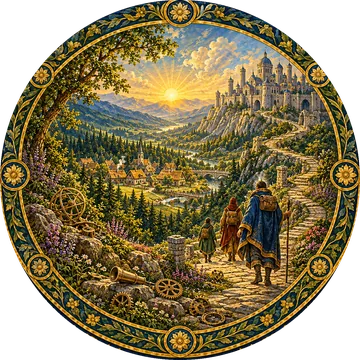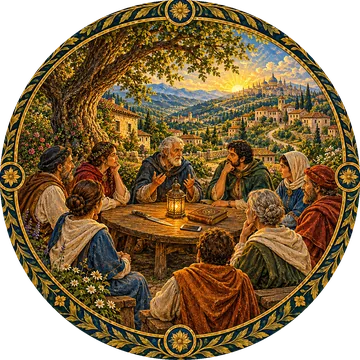
The Unsustainable Society lets scientists and inventors determine what morality is.
The Sustainable Society lets those who understand morality determine the direction in which science and invention proceed.
Science Has Many Directions
We often talk about science as if it were a single line, pointing either "forward" or "backward." It isn't. It's many lines, pointing in many directions, and we choose which ones to follow.
Every scientist chooses what to investigate. A scientist who studies hawks probably won't learn much about falcons, and the reverse. And an inventor who looks for ways to dominate and control Nature won't learn much about how to live in harmony with it.
There are as many directions as there are points on a compass, and more. We didn't have to go in the direction we did. We chose it, but we chose it unconsciously. Now we can choose consciously. And if we refuse to choose consciously, we'll still be choosing, just unconsciously, and usually by default, in favor of whoever has the most money and the fewest scruples.
Some inventions are bad. They may be complicated and impressive, but they make our lives and our world worse. An invention that makes the world worse shouldn't be built. And a society that refuses to take responsibility for the direction of its technology will hand the machinery to whoever wants it most, and will eat itself from the inside out.
So technology must answer to morality, and not the other way around. The question is: who steers?
Not a Planetary Body
One answer would be a single world authority, with the power to decide what technology everyone on Earth may use.
That would be a mistake. Any body powerful enough to steer the technology of the whole world would be the greatest prize there is, and it would be captured, sooner or later, by exactly the people we'd least want steering. It would also be the most technolatric institution ever built: one central system, deciding for eight billion people, with no way out.
It would also break the principle at the heart of the Earth Party's Blueprint: force and betterment are never held by the same hand. The body that may use force may do nothing but uphold the Law. The body that works to make life better may use nothing but persuasion and consent. (See The Republic of the Earth.)
The Amish Example
There's a better model, and it's been working for generations.
The Amish aren't against all technology. Each community decides for itself which tools to allow. There are dozens of Amish affiliations in America, and they often reach different conclusions. As one scholar of the Amish puts it, they ask whether a technology will "bolster our life together, as a community, or is it going to somehow tear it down?" (NPR)
The process starts from the ground up. Someone tries a new tool, and the community watches what it does. If it helps, it may stay. If it harms the family or the community, it's given up. One bishop told an early adopter he could try a new device, "but you have to be ready to give it up, if we decide it is not helping you or hurting others" (Kevin Kelly, The Technium).
The results are often surprisingly creative. Some communities share a single phone in a shanty at the end of the lane, so that it's used for what's needed and doesn't take over the home. Some allow tractors only with steel wheels, so they can work the fields but can't be driven on the road. Some use diesel engines to power farm machinery, while horses still pull it. Some tried credit cards, saw the debt that followed, and gave them up (Kevin Kelly, The Technium). As one Amish saying puts it, "We don't want to stop progress, we just want to slow it down."
Every Level Decides
The Earth Party would carry that idea to every level of society. The village decides for its own ground. The township decides for its jurisdiction, the city for its own, and so on, all the way up.
But the kind of technology each level decides on grows with its scale. Each level decides about the technology that works at its scale, and that reaches as far as its people do.
| Level | What it decides on |
|---|---|
| The Village | The tools of daily life on its common ground: screens in the commons, sprays on the gardens, engines on the footpaths, lights at night. |
| The Township | The machinery of craft and trade: power tools in the shared workshops, which machines run in the market, motor traffic on township roads. |
| The City | Heavy industry: factories, mills, rail, smokestacks, and what they may release into the air and water. |
| The Metropolis | Power and current: power plants, the electrical grid, broadcast towers. |
| The Widest Scale | The most far-reaching technologies: artificial intelligence, genetic engineering, nanotechnology, satellites. |
That follows the pyramid of technological emergence, and the layers of The Multi-Layered Economy. A village doesn't need to decide about the power grid, and a metropolis has no business deciding what a village allows on its footpaths.
And because the newest, most powerful technologies sit at the top of the pyramid, they face the widest and most demanding agreement before they can spread. That's as it should be. The more far-reaching a technology is, the more people it affects, and the more of them should have a say.
Rules by Consent
These decisions aren't orders backed by force. Under the Separation of Force and Betterment, they can't be. They're agreements among the people who live there, the way an Amish community's rules are kept by the people who choose to belong to it.
A few principles keep them that way.
- The Law of the Earth sets the outer limits. No community can agree its way around the Law, and no community can take away a right the Law protects. (See The Law of the Earth.)
- A smaller community can always be stricter. If a city allows something, a village within it can still say no on its own ground. But a larger community can't force a smaller one to accept a technology it has refused.
- Every community can change its mind. A tool can be tried, watched, and given up, the way the Amish do it.
- Everyone is free to leave. If you don't agree with your village's choices, you can find, or found, a village whose choices you do agree with. That freedom is what keeps the agreements honest.
Who Gets the Workshop?
Steering isn't only about saying no. It's also about what a community chooses to build.
Every community decides whom it gives its workshops, laboratories, land, and support to. A society that gives them to whoever promises the most power and profit will get more of the technology that's brought us here. A society that gives them to people whose minds are whole, and whose work serves Life, will get something very different.
That's the deepest form of steering. Not a ban, but a choice about where a people puts its attention, its talent, and its trust.
The Right to Say No
Technolatry's central claim is that technology is inevitable, and that no one can stop it. (See The Ten Tenets of Technolatry.) But the Amish have been saying no, community by community, for generations. And every one of us already says no to some technologies, in our own homes and our own lives.
The question isn't whether we steer. It's whether we steer consciously, together, at every level, or let the steering be done for us.