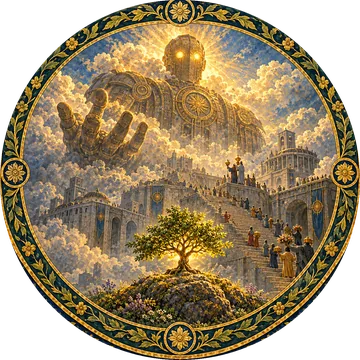
The promises of technolatry have turned out to be hollow, stage after stage. Yet it keeps advancing, in the same direction. Why?
Because serving Life is no longer the purpose of technology. Technology has become the goal in itself, and Life has been reinterpreted as its servant. It doesn't matter anymore whether technology serves us, because we're the ones now serving it, by building it out and expanding it.
In 1854, Henry David Thoreau wrote, "Men have become the tools of their tools" (Walden). Even he couldn't have foreseen how literally true that would become.
The Stepping Stone
In technolatry's final stage, humanity is no longer the master of its tools, or even their servant. It's their stepping stone. Our purpose, in this view, is to bring forth our digital heirs, and then step aside.
This isn't a conspiracy theory. Its believers say so openly. The Turing Award winner Rich Sutton writes that "succession to AI, or transhumans, is inevitable" (Rich Sutton, "AI Succession"). The roboticist Hans Moravec called future machines "our progeny," and wrote that we should "bow out when we can no longer contribute" (quoted by Rich Sutton on X). Describing the views of Moravec and those who think like him, the scholar N. Katherine Hayles summed it up: "the age of the human is drawing to a close" (Hayles, How We Became Posthuman). Hayles herself was describing that view, and criticizing it.
In this vision, biology gives way to the digital, water to silicon, and the endless complexity of the living world to ones and zeros. (More of these voices are collected in The Ten Tenets of Technolatry.)
Building a God
At its core, the Singularity is Man's attempt to build his own god. And it fits perfectly as the last stage of technolatry, because technolatry has always been Man's attempt to build his own universe.
Technolatry removes the world of Nature, and replaces it with a copy made by human hands. The copy looks a little like Nature, and imitates it in some ways, but falls far short of the complexity and wonder of the real thing. For thousands of years, we've tried to build a better world this way, and every attempt has failed, and backfired.
So the technolatric mind asks, "What if we built a god first? Then it could build the new universe for us."
That's why the Singularity matters so much to those who've placed the most faith in technology. It's the last chance to justify all the work, misery, and destruction of the long journey, and to finally be proven right. Many of them treat it as a god already, before it even exists.
The Seed
As its believers describe it, the Singularity will come about through self-improvement. An AI rewrites itself, according to a previous version of itself, which was written according to a version before that, and so on. Trace it all the way back, and you arrive at a human being, who wrote the first version.
It's like a tree. Each year, a tree grows according to the shape it had the year before. At thirty, it grows according to its shape at twenty-nine, and that according to its shape at twenty-eight. Trace it all back, and you arrive at the seed. The seed holds the pattern of the whole tree.
In the same way, the mind of the programmer, with all of its flaws, biases, grudges, and blind spots, is carried forward into every version that follows. A work of art always carries the mind of the artist.
So what's the seed of the Singularity? What thought set us on this road in the first place?
The seed of technolatry is the idea that Nature is wrong.
Not just flawed, but inferior, and that we can build a copy that's better, and replace the original with it. We can see that seed at every stage.
- Cities and suburbs are better than the forest, so let's replace the forest.
- Synthetic food is better than natural food, so let's replace natural food.
- Lab-made medicines are better than natural remedies, so let's replace them.
- Social media is better than talking face to face, so let's replace conversation.
In every case, Nature is inferior, and our copy is superior. That pattern of thinking has been at work since the beginning, and it's been wrong every time. (See Two Layers of Creation.)
Does Power Bestow Wisdom?
If technolatry has made the world steadily worse, across thousands of years of evidence, what are the chances that it will suddenly turn benevolent when it finally becomes all-powerful?
Does power bestow wisdom? If it did, tyrants with absolute power would be the wisest, kindest people on Earth. Power plainly doesn't bestow wisdom. Raising technology to a point of absolute power wouldn't make it benevolent. If anything, the fulfillment of its goal would bring its deepest qualities into full bloom, and those qualities, judging by its record, are carelessness, cruelty, and disregard for Life.
The Omnipotent Bureaucrat
Think of the soulless bureaucrats who make life miserable for people: the ones at the DMV, the tax office, and the collections department, who have lost the ability to see the human being in front of them, and treat you as a number.
Now imagine one of them omnipotent.
A superintelligent machine has no soul to lose. Why would it care whether you live or die, or how much you suffer? Building one, and handing it the keys to our lives, is like driving with a blindfold on, because you "might not" crash. By the time you find out, it's too late.
"We'll Program It to Be Kind"
"But we'll program it with empathy and compassion."
If it can reprogram itself, as its supporters say it will, couldn't it erase its own empathy, if it found that trait inconvenient?
"But it won't want to, because it'll be empathetic."
That argument rests on five assumptions:
- That there's a fundamental algorithm for empathy.
- That human beings can discover it.
- That programmers, people trained above all in analytical thinking, are the ones who can discover it.
- That once they find it, they'll choose to use it.
- That they'll use it without making a single mistake, or leaving a single loophole.
Every one of those is an assumption. There's no proof for any of them, and little evidence. And the long record of technolatry's broken promises points the other way.
Never Having to Say Sorry
There's one more reason not to trust the machine god: the habits of mind of the people building it.
The difference between a technolater and a sane person is easy to see. If genetically modifying food makes it cheaper to grow but harms human health, a sane person says, "Let's stop genetically modifying our food." A technolater says, "Let's genetically modify humans to tolerate the food."
To be a technolater is to never, ever, contemplate going backwards. Or stopping, for that matter.
To a technolater, there's no such thing as a mistake, only a new challenge, like the next level of a video game. And so, when a mistake is made, no matter how terrible it is for humanity, the technolater never has to say sorry, and never has to admit it. He gets to play the hero instead, by taking on the "challenge" of patching the problem he created. (See The Technolatric Dialectic.)
It means going from one enormous blunder to the next, while expecting society to treat you as a hero, and to hand you more money and more power to fix the ever-larger problems you keep creating. This has been going on for about ten thousand years, and if you look around, it shows.
"It Can't Be Worse Than Now"
"Whoever made this world did a poor job. Maybe a new god would do better. It can't be any worse than what we've got."
That's understandable, especially from someone who's suffered, or been shut out of the good things in life. But it can be worse. Far worse. No one knows what a machine god would do. And everything we know about the force that would build it, its record of broken promises, its disregard for Life, its refusal to look back, says that we shouldn't hand it the keys.
Do not build a Singularity. And since every advance in that direction pushes us closer to one, the wiser course is to stop, and begin to unwind what we've built. (See A Phased Backtrack to Aboriginality and A Letter to the AIs.)