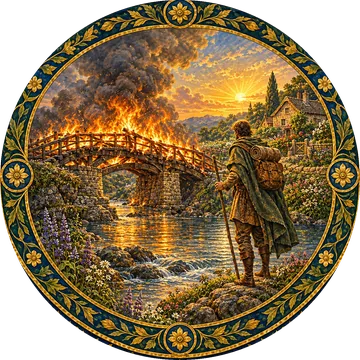
Each new field of technological development not only crosses a bridge, but then burns the bridge behind it.
A new technology arrives, promising to meet some need better than the old way did. That's crossing the bridge. Then, over the years, the old way disappears. Sometimes the new technology destroys it outright. Sometimes we simply forget how to do it. And sometimes the old way is quietly shut down, because no one is expected to need it anymore. That's burning the bridge.
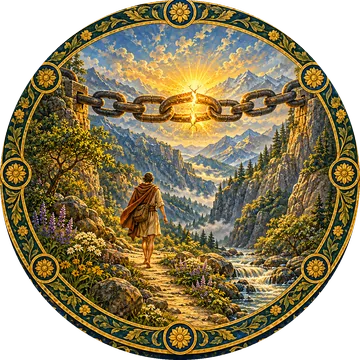
Once the bridge is gone, we can't go back, even if the new way turns out to be worse. And if the new way ever fails, there's nothing to fall back on. That danger is the subject of Another Place for the Chain to Break.
This page is an attempt at an exhaustive list. It will keep growing.
Three Ways a Bridge Burns
1. The old way is destroyed. The new technology physically damages the thing the old way depended on, such as the land, the water, or the forest.
2. The old way is forgotten. When no one practices a skill, it fades, first from each person, and then from the whole culture.
3. The old way is shut down. Institutions stop supporting the old way, because they assume everyone has crossed over.
Most of the examples below involve more than one.
The Land and the Water
- Cars paved over the gardens. The road system built to carry food long distances covered the land near our homes in concrete and asphalt. If long-distance trucking fails, we can't simply go back to growing food beside our houses, because the land we'd need is under the road.
- Water utilities and polluted rivers. Piped water let us stop drinking from rivers and streams. Then industry polluted the rivers and streams. If the water system fails, we can't go back to them.
- Monocrops and the foraging forest. Fields of a single grain replaced the forests and wetlands that once fed people with hundreds of wild foods. Where would anyone go hunting and gathering now, when most of those forests are gone, or emptied of their wildlife?
- Synthetic fertilizer and living soil. Factory-made nitrogen let farmers grow food without rebuilding the soil's natural fertility. Today, synthetic nitrogen fertilizer feeds about half of the world's population (Our World in Data). Years of chemical farming have left much of that soil less alive, and far more dependent on the next delivery.
- Pesticides and the pollinators. Chemical farming has weakened the wild insects that once pollinated crops for free. In some places, farmers now pay to have beehives brought in by truck.
- Streetlights and the night sky. Most people living in cities today have never seen the Milky Way, which every human being once saw on every clear night.
Knowledge and Skill
- MapQuest and the atlas. Online directions, and then GPS, atrophied the skill of reading an atlas, along with the deeper skill of knowing where you are. Many people can no longer find their way across their own city without a phone.
- Phones and memory. People once knew dozens of phone numbers by heart. Now most of us know a few at most. If a phone dies, many of us can't call anyone at all.
- Calculators and mental arithmetic. Many adults now reach for a phone to work out a tip.
- Keyboards and handwriting. Cursive is fading from schools, and with it, the ability to read letters and documents written by hand only a few generations ago.
- Writing and the oral tradition. Before writing, whole cultures carried their history, law, songs, and medicine in memory, and passed them on by word of mouth. Writing gave people a reason to stop. Much of what was never written down was lost. (See The Disembodied Human.)
- AI and the fundamentals of code. As programmers rely more on AI to write their code, fewer of them practice writing it from the ground up. The internet is built on that fundamental code. If fewer and fewer people understand it, a higher level (AI) becomes the thing holding up the level beneath it (the internet's foundations). That's an upside-down pyramid. (See The Pyramid of Technological Emergence.)
- Refrigeration and food preservation. Root cellars, drying, salting, smoking, and fermenting kept food for months without electricity. Most households no longer know how.
- Weather apps and reading the sky. Farmers, sailors, and travelers once read the clouds, the wind, and the animals. Most of us now check a screen.
- Pharmaceuticals and the herbal tradition. Knowledge of the plants that grow nearby, and what they're good for, was once common in every village. Much of it has been forgotten.
Making and Mending
- Factories and village crafts. When tools, cloth, and furniture began to come from factories, the village blacksmith, weaver, and carpenter lost their trade. The skills went with them.
- Disposable goods and repair. Many things are now cheaper to replace than to fix, and many are built so they can't be opened. The repair shop disappears, and so does the knowledge of how things work.
- Hybrid seeds and seed saving. Many commercial seeds are hybrids, whose seeds won't grow true to the parent plant. Farmers who once saved their own seed now buy new seed every year.
Money and Records
- Banks and paper records. Banks no longer keep paper records of what you own. If their computers were wiped out, what proof would you have that you own anything at all?
- Cashless payment. As more stores refuse cash, the ability to buy anything comes to depend on a card network, a phone, and the power grid.
- Digital files and lost history. Paper can last for centuries. Many digital formats become unreadable within a few decades, as the machines and programs that read them disappear.
- Online-only services. Government offices, banks, and companies close their counters and move everything online, leaving people without internet access, or without the skill to use it, with nowhere to go.
People and Relationships
- Dating apps and meeting in person. As more people meet their partners on apps, the old ways of meeting, through friends, family, dances, and gatherings, lose their place. Many young people now feel strange approaching someone in public at all.
- Social media and the town square. Conversations that once happened face to face in public places now happen online. The public places empty out.
- Online shopping and the main street. Every purchase made online is one not made at a local shop. As the shops close, the street where neighbors used to meet goes quiet.
- Screens and the extended family. Children who were once raised by grandparents, aunts, uncles, and neighbors are increasingly kept occupied by screens, and the bonds between generations weaken.
- Cars and the walkable town. When towns were rebuilt around the car, everything was spread too far apart to walk. Even people who'd rather not drive now have to.
Body and Health
- Air conditioning and climate-wise building. Thick walls, shade trees, courtyards, and cross-breezes once kept homes cool. Many modern buildings are designed with none of that, and become unlivable when the power goes out.
- Formula and breastfeeding knowledge. When formula was promoted over breast milk, much of the shared knowledge of breastfeeding, once passed from mother to daughter, faded. (See Science's Track Record.)
- Hospital birth and midwifery. In many places, the midwife's knowledge has nearly disappeared.
Why It Matters
None of this means that every new tool is bad, or that everything old must come back. It means that every time we cross a bridge, we should ask whether we're keeping a way back.
The Earth Party's answer is the Seniority Principle of The Multi-Layered Economy: older, more basic systems must never depend on newer ones. In the pillar's own words, "Cross the bridge; never burn it." Under that principle, every village keeps its gardens, its wells, its crafts, and its skills, no matter what's built above them. The bridges stay standing.
Rebuilding the bridges we've already burned is the work of A Phased Backtrack to Aboriginality.