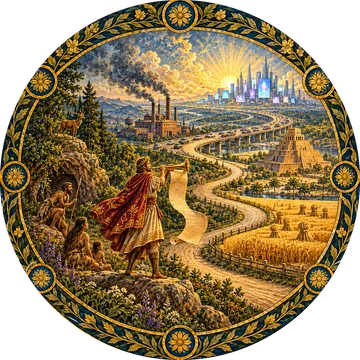
The healthy purpose of technology is to serve Life. Technolatry turns that around, and treats Life as the servant of technology.
That belief is rarely said out loud to the public. Instead, every new device, every new field of invention, and every new way of manipulating Nature is sold on the same promise: it will improve our lives.
Has it? We're surrounded by news that our newest technology is addicting us, making us sick in body and mind, breaking up our communities, concentrating power, and damaging the planet, without making us any happier. But this didn't start with smartphones. The same pattern shows up at nearly every great stage of technological "advancement," going back thousands of years.
So let's take a journey back through time, stage by stage, and compare what each one promised with what it delivered.
Before the Journey Begins
For almost all of human history, we lived by gathering and hunting, within our ecosystems rather than in place of them. That life had real hardships, including disease, injury, and sometimes violence. But it wasn't the life of constant toil that we're taught to imagine. Among foragers who live that way today, people work fewer hours than their farming neighbors (University of Cambridge), and the most traditional groups share food so widely that no one can hoard power over anyone else (Woodburn).
The first steps toward farming weren't a problem either. At first, people simply tended wild plants, such as wild wheat, chickpeas, and almonds, by clearing away competitors and watering them in dry spells. Later they planted seeds near their homes, while still eating mostly wild food. Some 23,000 years ago, at Ohalo II by the Sea of Galilee, people were already cultivating wild cereals on a small scale (PLOS ONE).
Slow, gradual, organic change of that kind isn't technolatry. The trouble began when technology stopped serving the people who used it, and began to be used to control them.
1. Monocrop Agriculture
Over thousands of years, small gardens turned into vast fields of a single grain. In Mesopotamia, farmers came to depend on irrigated wheat and barley, grown row after row as far as the eye could see.
The promise: More food, an end to hunger, food security, easier farming, and less work.
What happened:
- Hunger didn't go away. More food meant more people, and more mouths to feed.
- Food security got worse. A field of one crop can be wiped out by a single drought, pest, or blight. A wild ecosystem, with its hundreds of foods, is far more resilient.
- Health declined. A diet built on grain brought more tooth decay and poorer nutrition. Early farmers in Europe were about 4 centimeters shorter than the foragers before them (PNAS).
- The land wore out. Irrigation slowly salted the soil of southern Mesopotamia, and over centuries, harvests fell as farmers were forced from wheat to the hardier barley (Science).
- We worked more. Farmers work longer hours than foragers, and have less leisure (University of Cambridge).
Food storage also made something new possible. Granaries were first built as shared stores, as at Dhra' in the Jordan Valley about 11,000 years ago (PNAS). But whoever controls a granary controls the people who depend on it. Over the following millennia, in place after place, stored grain became the base of power for a ruling class.
How technolatry gained:
- Power began to centralize around whoever controlled the fields, the water, and the stores.
- People became dependent on a wider range of tools, which set off a new round of invention.
- New health problems weakened us in body and spirit, which made us easier to sell the next solution to.
2. Urbanization
Within a few thousand years, the farming villages of Mesopotamia grew into the first cities.
The promise: Efficiency, convenience, safety in numbers, and a richer life.
What happened:
- Inequality. Society split into classes, with kings, priests, and officials at the top.
- Disease. Crowded people, animals, and waste made the perfect home for epidemics.
- War. Cities fought cities. Tell Brak, in northern Syria, holds mass graves from around 3800 BC (Science), and nearby Hamoukar was destroyed in one of the earliest known battles between cities (Phys.org).
- Disconnection. People grew up surrounded by walls and streets, cut off from the living world their ancestors had known.
Cities didn't have to go that way. Some early ones didn't. At Mohenjo-daro, in the Indus Valley, inequality actually declined as the city grew (Antiquity). The difference was in how they were governed, not in the bricks.
How technolatry gained:
- Cut off from Nature, people had less intuition to check the next promise.
- More complicated lives created more demand for new inventions.
- Large populations in one place meant more hands to build them.
A Common Objection
"If you don't like farming and cities, why do you live in one? Why do you buy food at the supermarket? Why don't you go live in the woods?"
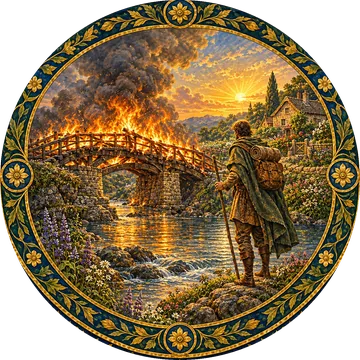
Part of the answer is that each stage of technology closes the door behind it. Where exactly would we go hunting and gathering, when most of the forests have been cut down or emptied of their wildlife? The rest of the answer is in Objections and Answers and Burning the Bridges.
And the Earth Party isn't asking anyone to abandon what we have. It's asking us to stop the frantic race to invent more, and to put what we already have in its proper place.
3. Metallurgy
The promise: Better tools, faster farming, and less work.
What happened:
- More people, not more rest. Faster farming fed larger populations, who were just as overworked as before.
- Bigger wars. Metal weapons made standing armies and empires possible.
- More inequality. Metal was scarce, and the wealthy got it first.
- Faster deforestation. People had already cleared forests with polished stone axes, but metal made it far faster, and smelting itself burned enormous amounts of wood. In the Epic of Gilgamesh, the hero's great deed is to cut down the sacred Cedar Forest and kill its guardian (Wikipedia).
How technolatry gained:
- War set off arms races, and arms races speed up invention like nothing else.
- Cleared forests made room for the empire of fields and cities to spread.
- Metal would one day become the body of every machine, including the computer.
4. Writing
The promise: Better records, more trade, more wealth, and a way to preserve history.
What happened:
- Writing began as bookkeeping. The earliest tablets from Uruk are accounts of goods and rations (CDLI), and some of the earliest lists record enslaved workers (CDLJ). Its first great use was keeping track of who owed what to whom.
- A new elite. The literate few gained a new reason to see themselves as above everyone else.
- Lost memory. Writing gave people a reason to stop passing down their traditions by word of mouth, and much of what was never written down was lost.
- Life in symbols. Writing began to pull the human mind out of the body and the present moment, into a world of symbols. That story is told in The Disembodied Human.
Every major invention has had its skeptics, people saying "wait, this isn't a good idea." They're usually ignored. As this journey shows, it's wiser to assume that any invention built for power and control will have consequences no one intended.
How technolatry gained:
- Writing became the main tool of control, through written laws and records of debt. The Code of Ur-Nammu, from around 2100 BC, is the oldest law code we know of (Britannica).
- A mind living in symbols has less access to intuition, which leaves it open to persuasion.
- Written rules became the backbone of bureaucracy, a kind of machine made of people.
5. Coercive Governance and Bureaucracy
The promise: Safety, order, and efficiency for everyone.
What happened: Rule by kings, officials, and tax collectors, backed by armies. In Uruk, laborers were paid their daily grain in mass-produced clay ration bowls, found by the thousands (Wikipedia). In the Epic of Atrahasis, written later, humanity itself is created to do the gods' work, after the lesser gods rebel against their labor (Livius).
How technolatry gained:
- Power centralized.
- People were trained in obedience to authority.
- Critical thinking was discouraged, and natural behaviors were forbidden.
- The soul was buried under rules.
A Pattern in the Evidence
Across the ancient world, the same thing tends to happen. A new technique appears first in a useful, shared form, such as a common granary, a feast that brings villages together (PNAS), or a tally of goods. Only later, often thousands of years later, is it captured by a few people and used to control everyone else. In our own review of the evidence for this site, the typical gap between the useful form and its capture was thousands of years.
That's an important detail. It means the problem isn't the tool itself. It's what happens when a tool grows past the scale at which the people using it can still control it. Some of the earliest large settlements in the Levant grew huge and then fell apart, as if people had tried the experiment and walked away from it (Tumultuous Times).
Now, fast-forward to the industrial age.
6. Fossil Fuels
The promise: Cheap, abundant power, freedom from hard labor, and plenty for everyone.
What happened:
- Mines and smoke. Coal brought dangerous mines, child labor, and cities choked with smoke.
- Poisoned air. Outdoor air pollution, mostly from burning fuel, is linked to millions of early deaths every year (WHO-air-quality-and-health)).
- A changed atmosphere. Burning fuel on this scale is changing the chemistry of the air itself.
- We didn't get our time back. Machines did more work, but people didn't do less.
How technolatry gained: Fossil fuels powered every machine that came after them, and made our food, our heat, and our travel dependent on a resource that will run out.
7. Mass Production
The promise: More things for everyone, and with them, more happiness.
What happened: We did get more things. But with less involvement in making them, we came to value them less. Quality fell, and the things we made lost their soul. We overate, and became fat and sick. We overstimulated ourselves, and new disorders followed. They're called the diseases of affluence.
How technolatry gained: Production was centralized. Instead of every village making its own tools, the tools came from factories, and we depended on whoever owned the factories. Power always benefits from centralization.
8. The Automobile
The promise: Get everywhere faster, and make life easier.
What happened: Everything was moved farther apart, so we spend about as much time traveling as before.
- Homes spread farther from each other, and from farmland and work.
- Space between houses brought loneliness, and the loss of everyday contact with neighbors.
- Gardens and farmland were paved over.
- Streets became dangerous, and silence became rare.
- Dogs lost the freedom to roam, for their own safety.
- With the land under asphalt, our food now comes from far away, by trucks on roads, fueled by oil.
How technolatry gained: The car filled our lives with more machinery than anyone a century earlier could have imagined. It became the very symbol of a "modern" society. And it made nearly everything we need depend on it. (See Another Place for the Chain to Break.)
9. Plastics and Chemicals
The promise: Cheap, clean, durable, disposable convenience.
What happened:
- Hormone-disrupting chemicals such as BPA leach from some plastics into food and drink, and were banned from baby bottles (Science's Track Record).
- Tiny pieces of plastic are now found in the ocean, in the soil, and even in human blood (Environment International).
- The "forever chemicals" used in nonstick pans and stain-proof fabric don't break down, and now turn up in water and in people around the world.
How technolatry gained: The chemical revolution, from plastics and nonstick pans to synthetic fertilizers and pesticides, made our food, homes, and bodies dependent on industrial chemistry.
10. Television
The promise: Entertainment, information, and a happier, more connected life.
What happened: Families sat in the same room without talking. Neighbors stayed home. The time once spent with other people went to the screen. And governments and corporations gained a way to send their messages into every home at once, far more powerfully than any newspaper.
How technolatry gained: A centrally controlled channel into every living room and bedroom, and weaker bonds between people, which left them easier to sway.
11. Computers
The promise: The paperless office, less work, more leisure, and knowledge for everyone.
What happened: We spend the working day in front of screens, and the work follows us home. The paper is still there, and now there's email too. Knowledge became easier to reach, but harder to trust, and attention grew shorter. And as more of the world was wired to computers, more of it came to depend on them.
How technolatry gained: Almost everything was rebuilt to run on digital systems, which became the foundation for everything that followed, including AI.
12. Smartphones
The promise: The internet anywhere, at any time, and a more convenient life.
What happened: The price of convenience was addiction. The whole point of convenience is to spend less time on a task. Yet many of us now spend much of the day on our phones. We no longer talk to the people standing beside us.
How technolatry gained: More time on computers, computers carried on our bodies at all hours, and surveillance everywhere.
13. Social Media
The promise: Connection to everyone, all the time, and an end to loneliness.
What happened: Messages on a screen don't meet our need for each other. They replaced what little face-to-face contact we had left, and we're lonelier than ever. In 2023, the U.S. Surgeon General declared loneliness an epidemic (HHS).
How technolatry gained: More time on computers, enormous stores of personal data to train AI, and weaker real relationships.
14. Artificial Intelligence
The promise: It will manage our society efficiently, solve our hardest problems, and make everything better.
What will happen: We don't know yet. But we know the track record of every stage before it, and we know that a machine able to beat us at chess still doesn't know how to live in a forest. The Machine God and A Letter to the AIs take up this stage in full.
What the Journey Shows
At every stage, the promise was the same: less work, more ease, a better life. At every stage, the result was more work, more complication, and more dependence, while technology itself grew more powerful.
That doesn't mean nothing good was ever invented. Within every field, there are individual inventions that help. You're reading this on a screen, and if it helps you, that's a benefit. But those benefits have only partly made up for the damage done by the fields they belong to.
When all of this is admitted, the defenders of technolatry fall back on one last argument: "It may not have made us happier, but it advanced technology, and that's good in itself. Someday it will cross a threshold and make everything wonderful."
When? No one can say. It's a faith, not a forecast. And a faith that asks us to keep sacrificing our health, our time, and our world for a reward that never arrives deserves to be examined. The rest of this section does that, beginning with Burning the Bridges.