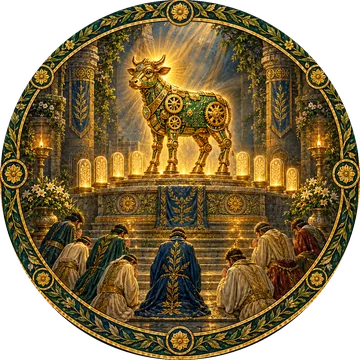
Technolatry is the worship of technology. The word comes from two Greek roots. The first is tékhnē, meaning art, craft, or skill, the same root that gives us technology (Wiktionary). The second is latreía, "worship," which also shows up in idolatry, the worship of idols (The Phrontistery).
In October 2023, one of the most powerful investors in Silicon Valley published a manifesto declaring that slowing down artificial intelligence is murder. "We believe any deceleration of AI will cost lives," Marc Andreessen wrote. "Deaths that were preventable by the AI that was prevented from existing is a form of murder." (The Techno-Optimist Manifesto)
That isn't an engineering opinion. Engineers talk about tradeoffs, risks, and failure rates. Calling hesitation murder is the language of faith, the kind that treats doubt as sin.
What the Word Means
To worship technology means treating our tools and techniques as though they were God: the source of salvation, the measure of progress, and the authority no one is allowed to question. Others have used the word before. Christian writers have described it as a form of idolatry (Back to God Hour), and scholars writing after the philosopher Achille Mbembe define it as near-religious reverence for technology, "perceived as infallible and as a solution to all social, economic and political issues" (Sociologia).
It isn't the same as technocracy, in the old sense, meaning government run by engineers and experts. Rule by experts is a result of technolatry, not its root. Before anyone hands power to the machine-builders, they first have to believe the machine is the answer.
It's a Slope
Hardly anyone holds every one of these beliefs. Most people hold the first one or two without noticing. But each belief makes the next one easier to accept, and the slope runs from a harmless-sounding premise all the way to the conclusion that humanity is disposable.
What's striking is that none of these beliefs have to be guessed at anymore. People at the top of the technology world have said them out loud.
Stage One: The Story
1. The story of the progress of humanity is the progress of technology.
This is where it starts, and it hardly feels like a belief at all. It's simply how history gets taught to us: stone, bronze, iron, steam, electricity, silicon. The story is told through tools. Wisdom, art, moral growth, and our relationship with the living world appear only as side notes.
Andreessen states it plainly: "Technology is the glory of human ambition and achievement, the spearhead of progress, and the realization of our potential." (The Techno-Optimist Manifesto)
Stage Two: The Fix
2. All solutions to all problems are technological ones.
Humanity should not have to introspect on its mistakes, nor change its ways, nor rediscover any spiritual principles, nor give up anything, nor humble itself in any way, because we can simply make the problem go away by inventing more technology. And if that new technology causes new problems, we can invent even more technology to solve those, and on and on we can go like this, forever. It's not folly, and it will never catch up to us.
In the manifesto's words: "We believe that there is no material problem – whether created by nature or by technology – that cannot be solved with more technology." (The Techno-Optimist Manifesto) Notice the phrase "or by technology." The cure for what technology breaks is more technology. (See The Technolatric Dialectic.)
3. All technological invention is good, and any technology that can be invented should be invented.
If there are downsides to its introduction, its benefits will outweigh them.
4. Even if a new technology does not make our lives better, it will still propel us toward greater overall technological complexity, and that will make our lives better.
(Eventually.) (Once it reaches a critical point of evolution.) (At some unspecified date in the future.)
The manifesto calls this accelerationism: "the conscious and deliberate propulsion of technological development... To ensure the techno-capital upward spiral continues forever." (The Techno-Optimist Manifesto)
Stage Three: The Hierarchy
5. Artifice is superior to Nature.
The things humans can make with our hands can be, and are ultimately destined to be, greater and better than the natural world we inherited.
For this belief to work, the natural world, including the human being, first has to be reduced to a machine. Yuval Noah Harari, the historian and a regular at the World Economic Forum, builds his view of the future on the premise that organisms are algorithms. "Humans are now hackable animals," he has said. "You know, the whole idea that humans have this soul or spirit and that they have free will... That's over! Free will, that's over!" (transcript via CBCG)
Once a human being is just an algorithm, a better algorithm is simply an upgrade. In Homo Deus, Harari writes that humanity "will now aim to upgrade humans into gods, and turn Homo sapiens into Homo deus." (CBC Radio)
Klaus Schwab, founder of the World Economic Forum, describes where the upgrade leads: "What the fourth industrial revolution will lead to is a fusion of our physical, our digital and our biological identities." (Chicago Council on Global Affairs)
Stage Four: The Succession
6. The purpose of biological Life is to serve as a stepping stone in the creation of artificial life.
7. Artificial life, being superior, will replace humanity once it gets going.
8. This replacement will be a good thing, because the world will be better that way.
Harari describes the stepping stone directly: "In the coming century, however, science is likely to usher the era of inorganic life shaped by intelligent design." (Wikipedia, quoting People's Daily Online) He has also said that "Homo sapiens as we know them will disappear in a century or so" (The Observer, via Wikipedia), and that with AI, "potentially we are talking about the end of human history—the end of the period dominated by human beings." (Fortune)
To be fair, Harari usually frames these as warnings, not wishes. But he accepts every premise underneath them: humans are algorithms, free will is over, and succession is coming. The disagreement is only about how to feel about it.
Others feel fine about it. According to Elon Musk's sworn testimony, when he asked Google co-founder Larry Page, "What if AI wipes out all humans?", Page "said that would be fine so long as artificial intelligence survives," and then called Musk a "speciesist" for caring about humans more than AI. (The Economic Times) MIT professor Max Tegmark, who described the argument in his book Life 3.0, wrote that Page accused Musk of "treating certain life forms as inferior just because they were silicon-based rather than carbon-based." (The Christian Post)
Rich Sutton, a Turing Award winner and one of the founders of modern AI, put it this way in 2023: "We should prepare for, but not fear, the inevitable succession from humanity to AI." (Rich Sutton on X) To support the point, he quotes the roboticist Hans Moravec, who called future machines "our progeny" and wrote: "It behooves us to give them every advantage, and to bow out when we can no longer contribute." (Rich Sutton on X)
Bow out. That is belief number eight, said out loud.
The Guardrails
The last two beliefs aren't steps on the slope. They're what keep anyone from getting off it.
9. This entire pathway is inevitable.
It's "destined," because technological progress is a one-dimensional line, a railroad with a set course that can't be altered. No steering wheel, only gas. The only question is how fast we will go.
Sutton's slides say it in five words: "Succession to AI, or transhumans, is inevitable." (Rich Sutton, "AI Succession") Harari uses the same railroad image: "the train of progress is again pulling out of the station – and this will probably be the last train ever to leave the station called Homo Sapiens." (CBC Radio)
10. Anyone wishing to restrict research or development, or any type of technology, or change the direction of innovation in any field, in any way, is backwards.
Andreessen doesn't call it backwards. He calls it evil. "Our enemy is the Precautionary Principle," he writes. "It is deeply immoral, and we must jettison it with extreme prejudice." (The Techno-Optimist Manifesto) Slowing down, as we've already seen, is "a form of murder."
Where This Came From
I wrote the list of ten tenets around 2018. There were no names attached to it then. I was describing an attitude I could feel underneath the way we talk about progress, one that was rarely said directly.
Since then, nearly every item on the list has been said directly, in manifestos, keynote speeches, conference slides, and sworn testimony, by some of the most powerful people in technology.
None of this means the people quoted here are villains in every respect, or that everyone who works in technology shares their faith. Most don't. But these are the beliefs that set the direction, and they're held by the people with the most money and power to act on them.
The next article answers each tenet, one at a time.