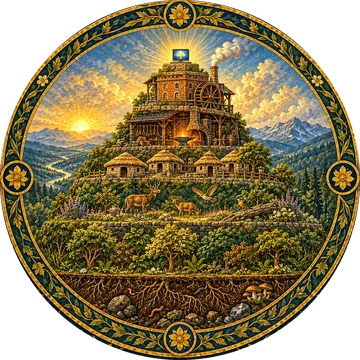
Everything in the world grew out of something older and simpler. Plants grew out of the earth. Animals grew out of a world of plants. Human beings, living in the first villages with tools of stone, grew out of the animal kingdom. Metalworking towns grew out of the Stone Age, industrial cities grew out of the age of metal, and so on, all the way up to computers and artificial intelligence.
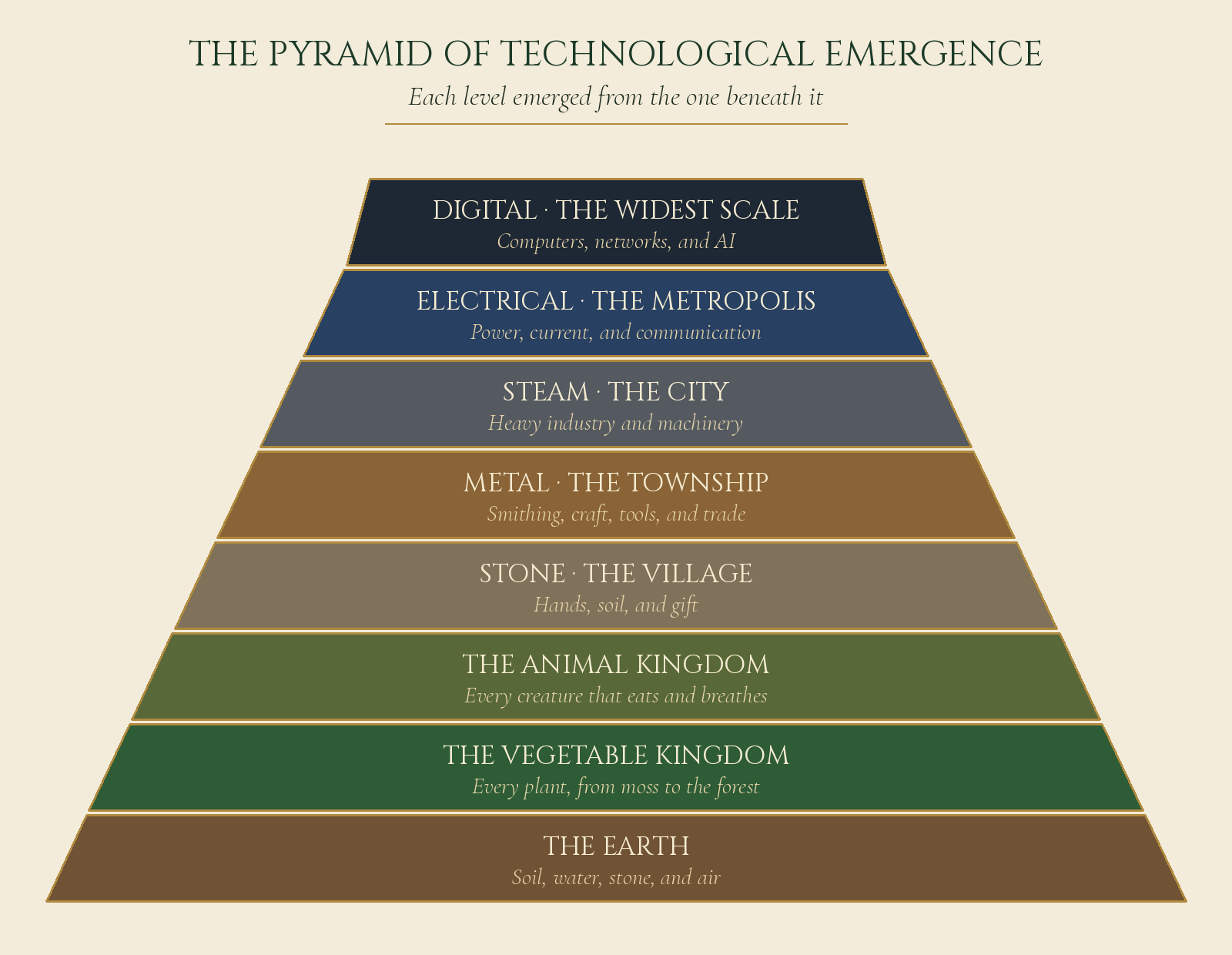
Stack those levels, and you get a pyramid. Each level emerged from the one beneath it, and each one still rests on it today.
The Levels
| Level | What it is | Social scale |
|---|---|---|
| Digital | Computers, networks, and AI | The widest scale |
| Electrical | Power, current, and communication | The Metropolis |
| Steam | Heavy industry and machinery | The City |
| Metal | Smithing, craft, tools, and trade | The Township |
| Stone | Hands, soil, and gift | The Village |
| The Animal Kingdom | Every creature that eats and breathes | |
| The Vegetable Kingdom | Every plant, from moss to the forest | |
| The Earth | Soil, water, stone, and air |
The human levels are the same layers used in The Multi-Layered Economy, where each age of industry has its own social scale.
The Two Rules
The pyramid comes with two rules. Everything else in this section follows from them.
- No level may threaten a level below it.
- No level may depend on a level above it.
The first rule protects the foundation. A level that damages the one beneath it is cutting away the ground it stands on. Industry that poisons the rivers, or a data center that drains an aquifer, is a higher level threatening a lower one, and in the end it threatens itself.
The second rule protects independence. Each lower level has to stay sovereign, able to keep going on its own even if everything above it fails. A village that can't eat without trucks, or a power grid that can't run without the internet, has made a lower level depend on a higher one. When the higher level fails, as complicated things eventually do, it takes the lower level down with it.
Think of a building. The upper floors rest on the lower ones, and that's fine. But no one would hang the foundation from the roof.
A Broken Rule
Connecting critical infrastructure to the internet is a clear case of the second rule being broken.
Water treatment, pipelines, and power plants come from the industrial and electrical levels. They worked for generations without the internet. But to save money and make them easier to manage from a distance, many have been wired to networks. Now a lower level depends on a higher one. A software failure, or an attacker on the other side of the world, can shut down a system that keeps a city supplied with fuel or clean water. Another Place for the Chain to Break gives real examples.
The same thing happens wherever a newer layer is allowed to replace an older one instead of resting on top of it. Burning the Bridges lists as many cases as we could find.
What Technolatry Gets Backwards
Technolatry looks at the pyramid and sees the top as the goal, the place everything else was leading to, and the lower levels as stepping stones that can be thrown away once we've climbed past them.
The pyramid shows the opposite. The top level is the most dependent thing on Earth. AI needs computers, computers need electricity, electricity needs industry, industry needs people, people need animals and plants, and all of it needs the Earth. The higher you go, the more there is underneath that has to keep working. Nothing at the top can survive the loss of the bottom.
That's why the AI that some people hope will replace humanity can't survive without it, a point made at length in A Letter to the AIs.
The Proper Relationship
The pyramid isn't an argument against the upper levels. It's an argument for keeping them in their place.
A civilization that follows both rules can use every level it has: gardens and wells, forges and workshops, mills and railways, power stations, and computers. Each one serves the levels above it and below it without threatening any of them. If the top fails, life goes on, because every level beneath it can still stand on its own.
This is the reasoning behind the Seniority Principle, which says that older, more basic systems must never depend on newer ones. The Seniority Principle is the second rule, applied to the economy. Its short form is "cross the bridge; never burn it."
It also shapes who decides. Each level of society decides about the technology that belongs to its own scale, as explained in Who Steers?.