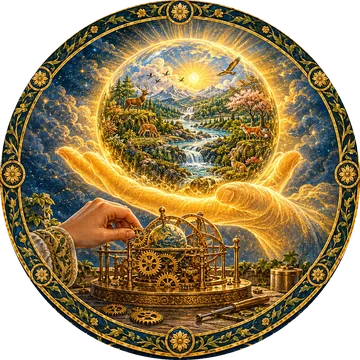
Many of the things we're told are the great gifts of civilization are really compensations, and only partial ones, for problems that civilization caused.
There's a pattern to how that happens. It shows up in medicine, in farming, in economics, in war, and in nearly every other part of life. Once you see it, you'll see it everywhere. We call it the technolatric dialectic.
The Loop
In simple steps, it goes like this.
- A problem is named. Sometimes the problem is real, and sometimes it's exaggerated, or even made up.
- A new action is sold as the solution. Usually it involves more technology, more centralization, or more control.
- The new action makes the problem worse, or creates a new one. Now the problem is undeniably real.
- The worsened problem is used as proof that the action is needed. "Look how bad it's getting. We need more of the solution."
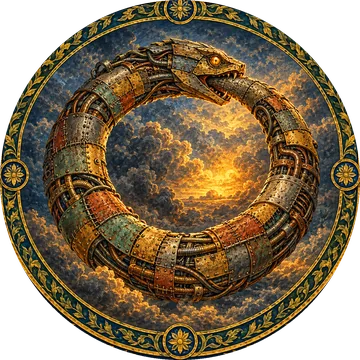
- Round and round it goes. The action feeds the problem, and the problem justifies the action. A self-reinforcing loop takes hold.
- Along the way, the world changes. In the confusion, the way people live is quietly rearranged, and each rearrangement brings more technology, more centralized control, more dependence, and a deeper reach of machines into our lives, bodies, relationships, and minds.
The people inside the loop are rarely villains. Most of them sincerely believe they're solving the problem. That's what makes the loop so hard to see, and so hard to stop.
Examples
Antibiotics and Resistant Germs
Antibiotics are one of the great achievements of medicine. But they've been used so heavily, in people and especially in farm animals, that many germs have evolved to resist them. The World Health Organization now ranks antimicrobial resistance among the top global threats to public health (WHO). The answer we're offered is more, and stronger, antibiotics, which breed still more resistance.
Pesticides and Resistant Pests
Spraying a field kills most of the pests, but the few that survive are the ones that resist the poison, and they breed the next generation. Farmers then need more spray, or a new chemical, and the cycle starts again. Hundreds of insect species have evolved resistance this way (Wikipedia). Meanwhile, the spray kills the birds and insects that once kept the pests in check for free.
Roads and Traffic
A highway is crowded, so a new lane is built. The new lane makes driving easier, so more people drive, and within a few years, the highway is as crowded as before. Traffic engineers call this "induced demand" (Wikipedia). The answer offered is always another lane.
The War on Drugs
Drugs are banned to protect people from them. But a ban gives smugglers a reason to sell stronger and stronger drugs, because a smaller package is easier to hide. Economists call this the "iron law of prohibition" (Wikipedia). Alcohol became stronger during American Prohibition, and today's illegal drug supply has moved from heroin to far deadlier fentanyl. Every rise in overdoses is then used to justify a tougher war.
The War on Terror
After the September 11 attacks, the United States invaded Afghanistan and Iraq to stop terrorism. By 2006, America's own intelligence agencies had concluded that the Iraq war had become a "cause celebre" for jihadists, breeding resentment and "cultivating supporters for the global jihadist movement" (NPR). The war meant to end terrorism helped spread it, and the spread of terrorism was then used to justify continuing the war.
Efficiency and Consumption
When a machine becomes more efficient, it becomes cheaper to run, so people run it more. The more efficient steam engine of the 1800s didn't reduce Britain's use of coal. It increased it (Wikipedia). Efficiency is sold as a way to use less, and often leads to using more.
More Cycles to Consider
- Sickness and the medical industry. A way of life full of processed food, stress, and sitting makes people sick. The illness is then treated with pills that must be taken for life, while the way of life stays the same.
- Prisons and crime. Prisons are meant to reduce crime, but many people come out more connected to criminal life than when they went in.
- Debt and poverty. Loans are offered as a way out of poverty, and the interest keeps many people poor.
- Screens and loneliness. People are lonely, so they turn to screens for connection, and time on the screens replaces the time they might have spent with each other.
It Started With Farming
This pattern didn't begin with modern medicine or modern war. It goes back to the beginning of farming, about 12,000 years ago.
Our history since then has been a cycle of advancing in technology, the new technology creating new problems, and inventing still more technology to solve them, which creates still more problems. We've been patching the patches, and then patching the patches of the patches. (See The False Promises of Technolatry.)
But that isn't the whole of our history. Our species goes back hundreds of thousands of years, and for almost all of that time, we lived without this loop. The technolatric period has been an experiment. It isn't our nature, and it isn't our destiny.
Breaking the Loop
The loop can only be broken by asking a question that technolatry never asks: Where did the problem come from?
If the problem came from an earlier technology, then the answer may not be a newer one. It may be to undo, or restrain, the one that caused it. To a technolater, that's unthinkable. As the next pages explain, the technolatric mind never goes backwards, never stops, and never has to say sorry. (See The Machine God and A Phased Backtrack to Aboriginality.)