Technolatry has given us new ways of meeting our needs. But the methods it uses have side effects that wear down the older systems that used to meet those needs.
And the story it tells us is that it doesn't matter if the old systems disappear, because the new systems can handle everything just fine.
But the new systems are more fragile than the old ones. Each new way technolatry gives us to meet a need is more fragile than the one before it, and all of them are more fragile than the original provider, Nature.
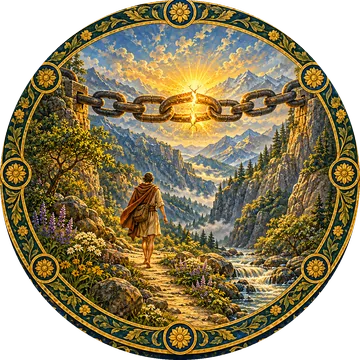
The reason is simple. Every new technology adds links to the chain that our lives hang from. And every link is another place for the chain to break.
Ten Minutes to Market
Say the market is ten minutes away on foot.
Now say it's ten minutes away by car, because everything has been spread farther apart. It takes the same amount of time. But look at what that trip now depends on.
Trucks to carry the food to the market.
Heavy machinery to build the trucks.
Fuel to power the trucks.
Fuel to power the heavy machinery that builds the trucks.
Heavy machinery to drill and refine the fuel to power the heavy machinery that builds the trucks.
Trucks to transport the raw materials to build the heavy machinery to drill and refine the fuel to power the heavy machinery that builds the trucks.
Heavy machinery to build the trucks to transport the fuel to power the heavy machinery to mine the raw materials to build the heavy machinery to drill and refine the fuel to power the heavy machinery that builds the trucks that transport the raw materials to build the heavy machinery to drill and refine the fuel to power the heavy machinery that builds the trucks that bring the food to our tables, and the water to our cups.
That puts our vital sustenance at the mercy of an enormous tangle of industrial machinery, with countless moving parts. Every one of them needs constant human labor, and unwavering competence, to keep it running. Many of them run on resources that will eventually run out. Sooner or later, some part of it will fail. And when one part fails, everything that depends on it can fail too.
Or we could use our feet.
Which just exist. Automatically.
It Has Already Happened
This isn't a thought experiment. Long chains break all the time.
- A tree in Ohio, 2003. A power line sagged into a tree in northern Ohio, and a software bug kept the alarm from sounding. Within hours, about 55 million people across the northeastern United States and Canada had lost power (Wikipedia).
- The Texas freeze, 2021. In February 2021, a winter storm knocked out much of the Texas power grid. Millions of people went without heat for days, and hundreds died. Because water treatment plants and pumps also lost power, millions more were told to boil their water, if they could boil it at all (Wikipedia).
- One password, 2021. In May 2021, a ransomware attack shut down the Colonial Pipeline, which carries fuel to much of the eastern United States. Within days, panic buying had emptied gas stations across the Southeast (Wikipedia).
- One update, 2024. In July 2024, a faulty software update from a single security company crashed millions of Windows computers around the world at once. Flights were grounded, hospitals postponed procedures, and banks and broadcasters went dark (Wikipedia).
In every case, a single broken link, far from the people who were hurt, cut off something basic: heat, water, fuel, care, or travel.
Nothing to Fall Back On
What makes this so dangerous is that the new systems also destroy the old ones. If the newer, more fragile system collapses, we may not have the older system to fall back on.
- If the drinking-water system fails, we can't go back to drinking from the rivers and streams, because industry polluted the rivers and streams. (Unless, of course, we stop polluting them.)
- If long-distance food transport fails, we can't simply go back to growing food beside our homes, because the roads built for that transport covered the land we'd need for growing it.
- If the stores stop taking cash, and the card network goes down, we can't buy anything at all.
Technolatry built a new system by wearing down the original one. Now, if the newer, more fragile one breaks down, we'll have neither. That's Burning the Bridges.
This is what technolatry does at every step. And every further step we let it take will add more links. The further it advances, the more precarious our civilization becomes.
Shortening the Chain
The way out isn't to throw away every machine. It's to make sure that the things we need to live never hang from a long chain.
Under the Seniority Principle of The Multi-Layered Economy, older, more basic systems must never depend on newer ones. Food grows close to home. Water comes from clean wells and streams. The village can feed and shelter itself on foot. Newer layers, from the forge to the computer, can rest on top of that foundation, but the foundation never rests on them. (See The Pyramid of Technological Emergence.)
That way, when a link breaks somewhere far away, as links always do, life goes on.