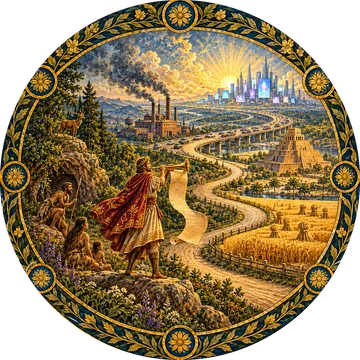
Two people are talking. One of them believes in technology. The other has a question.
What's It For?
Skeptic: What's the purpose of technology?
Believer: What do you mean, what's the purpose of technology?
Skeptic: It's something we spend an enormous amount of time and energy creating. And whenever we spend time and energy on something, there's a purpose behind it. So what's the purpose?
Believer: To solve problems, I suppose. Each technology is designed to solve some particular problem.
Skeptic: We'll come back to that. But before the particular problems, what was the original purpose? When the first person picked up a stone and shaped it into a tool, what was he hoping for?
Believer: To make life easier. To reduce work. Ask an anthropologist, and that's what most of them will tell you.
Skeptic: All right. Then let's check whether it worked.
Do We Work Less?
Skeptic: Do we work less now than our ancestors did?
Believer: We must. We have machines for everything.
Skeptic: There are still people living by hunting and gathering, in places like the Philippines, the Amazon, and the Congo. When researchers from the University of Cambridge studied the Agta of the Philippines, they found that those who still foraged worked about 20 hours a week. Those who had switched to farming worked about 30. Women in the most agricultural camps had half the leisure time of women who foraged (University of Cambridge).
Believer: That's just farming. We're far beyond farming now.
Skeptic: And do you work 20 hours a week?
Believer: Well, no. Forty, at least. More, some weeks.
Skeptic: And that's only your job. When you get home, you're still working. You're cooking, washing dishes, doing laundry, making the bed, and wiping down the counters. You're answering emails, reading texts, writing texts, and ordering things online. You're doing upkeep on the house, on your clothes, on your computer, and on your car. And then there's the driving. And the waiting, in line at the post office, at the DMV, and at the counter of the restaurant.
Believer: I never thought of all that as work.
Skeptic: What else would you call it? It isn't rest, and it isn't play. Most people are working nearly every hour they're awake. When they finally stop, they're too tired to dance, or make music, or make love, so they turn on the television and fall asleep in front of it.
Meanwhile, the foragers spend much of the day talking, joking, playing, singing, dancing, and making things for the pleasure of it.
So you tell me. Did technology succeed at its central purpose?
Believer: It doesn't look like it.
Solving Its Own Problems
Believer: But technology solves real problems. That has to count for something.
Skeptic: Where did the problems come from?
Believer: What do you mean?
Skeptic: Take email. Someone makes a better email program, and now you spend ten percent less time answering your email. That's a real improvement. But you wouldn't be answering email at all if no one had invented it.
When email arrived, in the 1990s, it was just a fun way to keep in touch without paying for a phone call. Did anyone in 1995 imagine it would become a duty? You get 24 hours in a day, and maybe 16 of them awake. Now some piece of every one of those days, five minutes or an hour, belongs to email, for the rest of your life.
We signed away a piece of every day, so we could say hello to our cousins without a phone bill. Was that a good bargain?
Believer: Put that way, I'm not sure.
Skeptic: That's the pattern. In most cases, the problem a new technology solves was created by an older one. The new invention patches the old one, then creates its own problems, which call for the next patch. It's described in full in The Technolatric Dialectic.
But Life Is Better
Believer: Fine. Maybe it doesn't reduce our work. But it makes life better.
Skeptic: How?
Believer: Look at everything we have. Look at what we can do. Our ancestors couldn't have imagined it.
Skeptic: We have more toys, that's true. Dazzling lights, endless entertainment, things our ancestors could never have imagined. But are people happy?
Believer: Some are.
Skeptic: In the United States, about one adult in eight takes an antidepressant (CDC). Millions more get through the day on alcohol, sleeping pills, or illegal drugs. A society full of wonderful toys, where so many people can't get through life without a pill, is not a happy society.
Is that really worth being pulled out of our own nature?
It'll Get Better
Believer: Maybe it isn't making us happy yet. But it will. At some point, the technology will become so good that it changes everything, and our lives will get much, much better.
Skeptic: How do you know?
Believer: It's where things are heading.
Skeptic: If something has behaved one way for its entire history, why would it suddenly start behaving the opposite way? When is this turning point supposed to arrive? At what level of technology? In what year? Will either of us be alive to see it?
And if you can't answer any of that, how can you gamble the whole condition of mankind on it? How can you bet our entire civilization, and our entire species, on the hope that the thing that has made our lives harder all this time will suddenly turn around and make them easier?
The Last Argument
Believer: All right. I'll be honest. Maybe it won't make us happier. But eventually, it will lead to something better than us. AI is the next stage of life, and humans are a stepping stone on the way there. If we have to suffer to give birth to a new civilization of machines, so be it. Once AI replaces us, everything will be wonderful.
Skeptic: Except that we won't be there.
Believer: Neanderthals aren't around anymore. Neither are saber-toothed tigers. One day humans won't be around either, and something else will take our place. That's evolution.
Skeptic: How dare you.
No one has the authority to make that decision. You don't have the authority to erase humanity. Did you ask the rest of us whether we wanted to be erased?
Think about how violent a threat that is. If someone threatens to kill one person, the police get involved. If someone threatens to attack a school, the police come in force. But when someone says the entire human race should be replaced, he gets invited to give a keynote speech, and hardly anyone bats an eye.
Something is deeply wrong with that.
Where This Leads
The dialogue ends where every honest conversation about technolatry ends. Technology didn't reduce our work. It created most of the problems it now solves. It gave us toys but not happiness. And when all of that is admitted, the last argument left is that humanity should be replaced.
That's not a reason to abandon every tool. It's a reason to stop treating technology as a god. The False Promises of Technolatry follows the same pattern back through ten thousand years of history.